Do MagSafe phone cases protect your phone from drops

MagSafe cases usually offer moderate drop protection due to thin to medium bumpers, and their magnetic hold can weaken during vigorous movement. Magnetic strength and drop resistance vary substantially between iPhone models and case brands; treat any single numeric claim as an estimate derived from independent measurements, and test your exact phone + case + mount combination before relying on it in workouts.
On this page (8 sections)
- Remember this
- What protection does a MagSafe case offer the phone?
- Does a MagSafe case maintain magnetic hold during movement?
- Can any phone case be made MagSafe compatible?
- What does MagSafe mean for phone cases and mounts?
- Do MagSafe cases protect the phone and keep it held during workouts?
- How to improve phone security with MagSafe cases during training
- FAQ
Part of our guide on effect of cases on magnetic mount hold
Fast facts
- Drop protection
- Moderate for many slim MagSafe cases; varies by case and material
- Magnetic force
- Estimated and variable — see references and measurement guidance
- Compatibility
- MagSafe-certified cases and mounts only
- Gym hold reliability
- Variable; often insufficient without added mechanical retention
- Extra securing
- Often recommended (clips, straps, locking mounts)
Remember this
- MagSafe cases typically protect against scratches and low-height drops but are not equivalent to heavy-duty rugged cases.
- Reported magnetic pull forces vary; independent reviewers measure a broad range and published numbers should be treated as case- and-test-dependent estimates.
- Magnetic hold often weakens during dynamic motion (running, jumping, heavy lifting); additional mechanical retention is recommended for vigorous activity.
- Not all cases are MagSafe-compatible; magnet placement, case thickness and materials affect both protection and magnetic coupling.
- If you need reliable security during workouts, use a MagSafe mount with mechanical clips or straps and test the arrangement under expected motion.
What protection does a MagSafe case offer the phone?
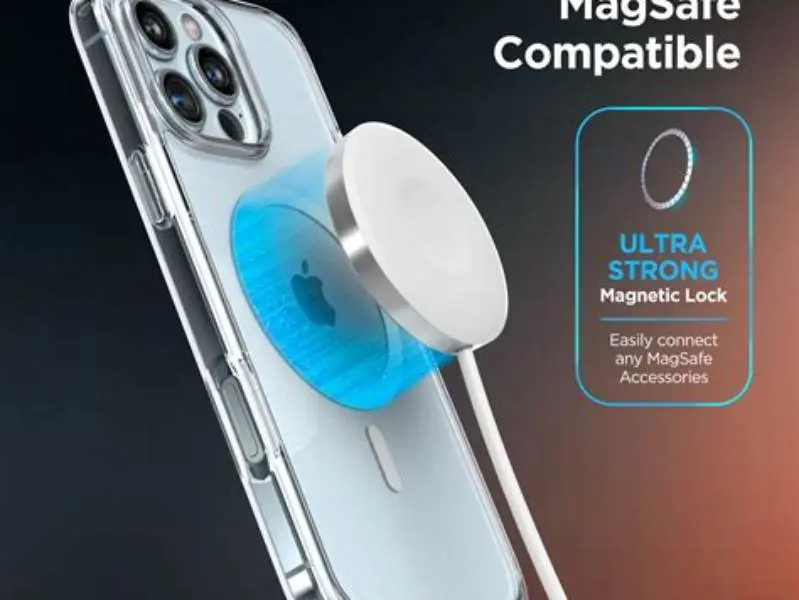
MagSafe-compatible cases vary widely, so general statements about protection are estimates rather than certainties. Many slim and hybrid MagSafe cases are thin by design; independent drop testing across reviewers and testing organizations shows useful protection from low-height drops onto flat, hard surfaces, but results depend on model, materials and test method. Published tester drop-height examples commonly cover short, hand-height drops in the range of roughly 0.8–1.5 m in practical scenarios, with rugged cases tested for higher heights (sometimes 1.8–2.4 m) [Consumer Reports; The Verge; PhoneBuff]. Apple does not publish an official drop-height rating for MagSafe cases, and independent tests produce varying outcomes, so treat numerical drop-height ranges as indicative, not guaranteed.
The protective effect mainly comes from the case material and geometry: shock-absorbing polymers (TPU, silicone) and raised lips around the screen and camera spread and absorb impact energy. Compared with heavy-duty, multi-layer rugged cases, most MagSafe cases omit corner air cushions, thick inner frames, or reinforced polymer cores; that design trade-off yields moderate protection rather than heavy-duty impact resistance. By “moderate protection” I mean a reduced risk of surface scratches and a lower chance of frame dents on common slips and short drops, not assurance against catastrophic impacts or repeated high-energy drops.
Scratch and scuff prevention is a baseline benefit: the back and edges are covered, and raised bezels help when the phone is placed face down. Still, protection varies by case thickness, materials, and the precise magnet assembly; thicker inner liners can improve shock absorption but may interfere with magnetic coupling. For high-risk activities (repeated drops, concrete falls, or worksite use) choose a purpose-built rugged case instead of relying on a MagSafe case alone. For numeric comparisons, consult test reports from Consumer Reports, The Verge, PhoneBuff, Wirecutter or other independent testers that publish test parameters and measured drop outcomes.
Does a MagSafe case maintain magnetic hold during movement?
MagSafe-compatible cases include a magnet array intended to align with the phone’s MagSafe magnets, but Apple does not publish an official pull-force figure and magnet strength varies between manufacturers and case designs. Independent reviewers who measure pull force (using spring scales, luggage scales, or purpose-built pull-force rigs) report a broad spread of results. Because of that variability, any stated magnetic-hold ranges should be treated as case- and-test-dependent estimates rather than universal constants [iFixit; JerryRigEverything; several product teardown and review channels]. It helps to understand does magsafe work with wireless charging before going further.
To give context from independent measurement approaches: testers measuring static pull or peel force have reported results that differ by an order of magnitude depending on the case, measurement orientation, and whether an accessory (wallet, ring) is attached. Some reviewers report static pull measurements on the lower side (fractions of a newton) for slim cases, while reinforced magnet assemblies in specialized mounts can show substantially higher pull readings. Because testers use different tools and units, comparing absolute numbers requires careful reading of each test’s method: see the cited reviews for measured values and methods.
Dynamic activities (running, rowing, or vigorous gym movements) introduce lateral and inertial forces that can exceed static magnetic attraction. Third-party tests and practical experience show phones fixed only by MagSafe magnets can shift or detach under sudden jolts; the risk increases with heavier accessories attached or when case materials increase the distance between magnet and phone. Manufacturers differ in magnet count, magnet geometry, adhesive method and internal liner thickness, so magnetic pull force and behavior under motion vary by case model and iPhone generation (heavier phones or phones with larger camera bumps change leverage and center-of-mass behavior).
If you intend to rely on MagSafe during exercise or transport, test the exact combination of phone, case and mount in the conditions you expect. To measure pull force yourself, attach the phone + case to the mount, then pull perpendicular to the mount using a small luggage or spring scale and record the peak force; repeat in orientations resembling your expected motion. For dynamic testing, simulate jolts by applying lateral impulses and observing whether the phone shifts. For published pull-force tests, consult independent reviewers who document their measurement setup and units (links in the author note). The other half of this decision is magnet requirements for static phone mounting.

Can any phone case be made MagSafe compatible?
Not every phone case can be made MagSafe compatible due to the need for a precisely positioned magnet ring that must match the iPhone’s magnetic array. Cases must be designed or certified specifically for MagSafe, embedding magnets in the right arrangement and using materials that don’t block the magnetic field.
DIY attempts to add magnets to non-MagSafe cases often fail because of poor alignment, weak or uneven magnetic strength, or interference from the case materials themselves. Thick or metal cases tend to block magnetic connections, reducing hold drastically.
Certified MagSafe cases are manufactured with properly positioned magnet rings to ensure consistent alignment and wireless charging. For non-certified alternatives, adhesive metal plates or third-party mounts can create partial compatibility but often at the cost of charging efficiency and magnetic strength.
If your current case lacks MagSafe, buy a certified MagSafe-compatible case or a thin case explicitly designed to preserve the magnetic connection and wireless charging performance.
MagSafe cases offer moderate drop protection but alone can’t guarantee phone security during vigorous workouts — test your exact setup or use mounts with mechanical retention.
What does MagSafe mean for phone cases and mounts?
MagSafe establishes a standardized magnetic connection system that allows compatible cases and mounts to align and support wireless charging and accessory attachment. For cases, this means embedding a ring of magnets inside the back panel designed to match the iPhone’s built-in array.
For mounts, MagSafe compatibility means matching the magnet polarity and arrangement to snap the phone in place quickly and hold it under light forces. However, mount designs vary widely in magnet size, spacing, and added mechanical retention features.
MagSafe enhances convenience for hands-free setups (gym racks, bike mounts, and car mounts) but magnetic hold alone is not a guarantee of security during active movement. Many mounts pair magnets with grips, clips, or straps to provide the mechanical retention necessary for motion.
Understanding MagSafe’s limits helps you choose the right combination: a thin MagSafe-certified case for everyday convenience plus a mount with mechanical retention for workouts or driving when motion creates significant inertial forces.
Do MagSafe cases protect the phone and keep it held during workouts?
MagSafe cases generally provide moderate protection against scratches and minor drops, but they are not heavy-duty shock absorbers. Their magnetic ring offers alignment and static attachment suitable for charging and many low-movement mounts. Independent pull-force tests vary; reviewers’ published static pull or peel numbers are case-dependent and should be consulted directly for specific models rather than relying on a single number [see references].
During exercises like squats, deadlifts, or cycling, the phone experiences lateral jolts and inertial forces that can overcome magnetic attraction. Cases alone rarely keep phones securely fixed without additional mounts or straps during vigorous or unpredictable movement.
Practical tests and reviewer videos show the magnetic hold is strongest when contacts are flat, clean and properly aligned. Sweat, textured surfaces or dust reduce adherence. Many gym-oriented mounts combine MagSafe magnets with mechanical clips or straps to compensate for this in real-world conditions.
If you want your phone held hands-free in the gym, use a MagSafe mount rated or described for dynamic forces, or add a strap or clip. Test the phone + case + mount in an environment that replicates your intended activity to verify reliability.
| Case Type | Drop Protection | Static Magnetic Hold (typical reported range & notes) | Hold During Workout Movement |
|---|---|---|---|
| MagSafe-certified slim case | Moderate (many reviewers show protection for short drops ≈0.8–1.5 m; varies by model) [Consumer Reports; The Verge] | Variable — many independent testers report low-to-moderate pull forces; see model-specific tests (units vary between reviewers) [iFixit; YouTube reviewers] | Unreliable in strong jolts without added mechanical retention |
| Rugged heavy-duty case | High (often tested to higher heights; some rugged cases are certified to higher-impact specs in independent tests) | Often not MagSafe-enabled (or magnets are weak/absent) | N/A for magnetic mounting; mechanical mounts usually required |
| Non-MagSafe case + metal plate | Varies (depends on plate placement and case thickness) | Inconsistent; magnetic coupling often weaker and interferes with wireless charging | Poor — mechanical retention recommended |
| MagSafe mount with clip | Depends on case | Higher effective retention because magnet + clip work together | Good if clip/strap is used to provide mechanical retention |
How to improve phone security with MagSafe cases during training
First, verify your case is MagSafe-certified and designed for the iPhone model you use. Certification or clear manufacturer documentation is the fastest way to know magnet placement and compatibility.
Second, test your phone on the specific mount or surface you plan to use during workouts. Simulate the movement you expect and, if possible, measure static pull force with a small luggage scale or spring scale by pulling perpendicular to the mount and noting the peak reading. For dynamic testing, simulate lateral jolts and observe for shifts or detachment.
Third, consider accessories like silicone straps, clips, or secure mounts that attach to gym equipment. These provide mechanical retention beyond magnetic force alone.
Keep the case and mount clean and dry. Dirt or sweat buildup reduces magnetic grip and increases the chance of slipping, especially during heavy training.
- Check whether your phone case is MagSafe-certified for your iPhone model.
- Test magnetic hold strength on your intended mount using a scale or simulated motion.
- Add mechanical securing accessories if the hold is weak.
- Maintain cleanliness of surfaces and magnets to preserve grip.

Magnetic Phone Holder Clamp Mount
Has 20× N52 grade magnets and a claw clamp for mechanical hold, ensuring strong magnetic and mechanical security for phone mounts.
FAQ
Can MagSafe cases prevent all phone damage in a gym?
No. MagSafe cases offer moderate protection against minor drops and scratches but not against high-impact falls or crushing. For serious protection, a rugged case is better.
Will the magnets interfere with wireless charging through the case?
MagSafe-certified cases are designed to align magnets and enable wireless charging without interference. Improperly placed magnets or metal inside other cases can block charging; consult manufacturer guidance and independent tests if unsure.
Are all magnetic mounts safe for use during workouts?
No. Only mounts designed for dynamic activity with strong magnets plus mechanical retention reliably hold phones during vigorous movement. Look for mounts that explicitly advertise dynamic-use retention and check independent test videos or reviews.
Can I add MagSafe compatibility to an existing case?
Adding magnets yourself rarely works well because of alignment and strength issues. Buying a certified MagSafe-compatible case is recommended.
What should I do if my phone slips off my MagSafe mount while exercising?
Add mechanical retention like clips or straps, reduce case thickness, or switch to a stronger mount designed for active use. Test different combinations and consult independent pull-force data for the specific mount and case.