Which gauss meter measures a MagSafe ring sticker’s field strength reliably

Choose a handheld gauss meter with a Hall-effect (or equivalent low-field) sensor, a low-range capability (sub-1 to a few gauss resolution), and a small probe tip to detect the highly localized field produced by a MagSafe ring sticker. Expect only approximate surface-level flux densities; use the meter to compare relative strength between stickers, cases, and mounts rather than to derive absolute pull-force without complementary mechanical testing.
On this page (9 sections)
- Fit check
- Remember this
- What a MagSafe ring sticker is and what it’s made of
- How to measure a MagSafe ring sticker’s magnetic field strength (single consolidated measurement-distance instruction)
- Which gauss meter features matter for these weak, localized fields
- Specific gauss meter models and brands to consider
- How to interpret readings in terms of mount holding potential (approximate guidance, not a guarantee)
- How phone case materials and environmental factors affect measurements
- FAQ
Part of our guide on magnetic mounts and overheating

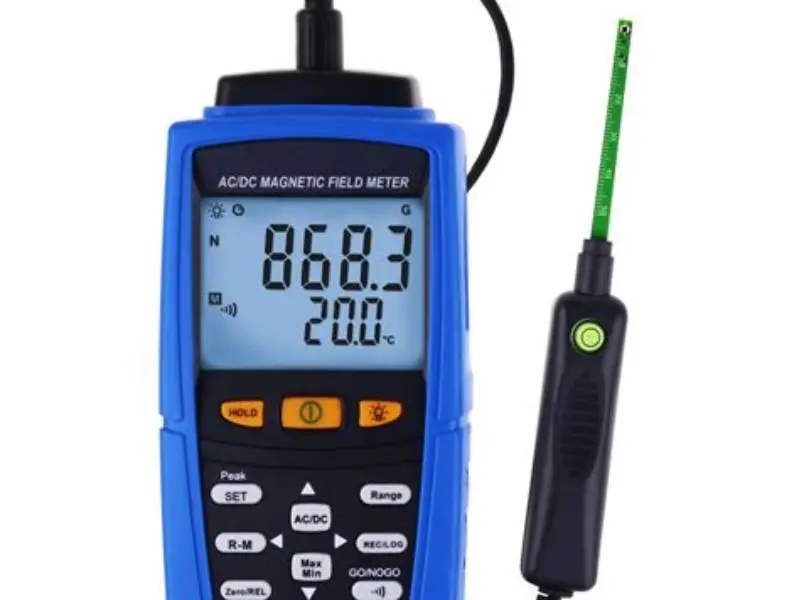
ZOEYEC TD8620 Digital Handheld Gaussmeter Permanent Magnet
Gives a resolution of 0.01mT (0.1 gauss) which is well below 1 gauss, suitable for detecting small neodymium
Check it on Amazon| Product | sensitivity in gauss and probe size | Verdict | |
|---|---|---|---|
| ZOEYEC TD8620 Digital Handheld Gaussmeter Permanent Magnet Surface ZOEYEC | Resolution 0.01mT = 0.1 gauss, better than 1 gauss threshold | Meets it | View on Amazon |
| Eacam Portable Digital Gauss Meter 200-2500mT Range with Backlit Eacam | Minimum measuring range 200mT = 2000 gauss, exceeds 1 gauss threshold | Short by 199900% | View on Amazon |
Fast facts
- What a MagSafe ring sticker is
- A small assembly of permanent (usually neodymium) magnets arranged in a ring to provide magnetic attachment for phone accessories
- Typical surface flux density (approx.)
- Varies widely by magnet grade/size and measurement distance; report and compare as an approximate range rather than a single value
- Sensor type to prefer
- Hall-effect or other low-field capable sensors
- Sensitivity needed
- Ideally ≤1 gauss resolution for reliable low-field detection
- Probe guidance
- Small, point-like probe; keep as close as reasonably possible (≈1–3 mm) and scan for the peak
Remember this
- A MagSafe ring sticker is a small assembly of permanent magnets (usually neodymium) arranged to create a localized ring-shaped field; typical surface flux densities are highly dependent on magnet grade, size, and measurement distance and are best reported as approximate ranges
- Use a gauss meter with a Hall-effect sensor and good low-field resolution (ideally ≤1 gauss) and a small probe to capture the localized peak field
- Readings are an approximate guide to holding potential; actual holding force also depends on magnet geometry, gap thickness (case), and mount design
- Environmental magnetic sources and phone-case materials (especially ferrous or thick polymer layers) can change readings: account for them when testing
- Consolidate probe-distance practice: keep the probe as close as practically possible (typically a millimeter or two) and record the peak while scanning the ring
What a MagSafe ring sticker is and what it’s made of
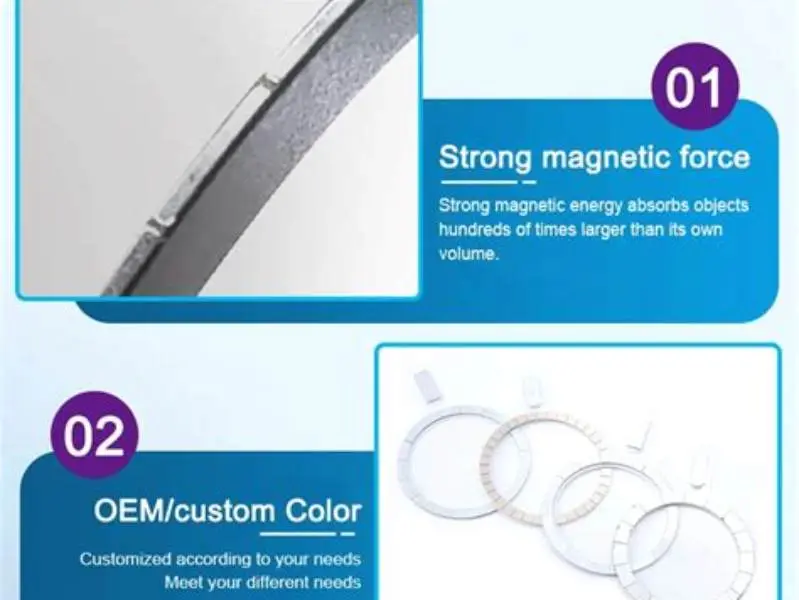
A MagSafe ring sticker (sometimes sold as a MagSafe-compatible adapter or magnetic ring) is a thin adhesive-backed assembly that attaches to a phone case or accessory to provide magnetic coupling with MagSafe-compatible mounts and chargers. It is not a single monolithic magnet but typically a small arrangement of permanent magnets (most commonly neodymium (rare-earth) magnets) embedded or housed in a thin plastic ring. Manufacturers vary the number of magnets, their grade (for example N35, N45, N52), their orientation, and any steel or soft-iron pieces used to shape the field. Those choices determine the local flux density (what a gauss meter measures) and the mechanical holding force.
Because the magnets are small and often arranged in a ring, their field is sharply localized: peak flux density occurs very close to the magnet surface and falls off quickly with distance. For that reason, gauss measurements of these stickers are sensitive to probe size, probe-to-surface distance, intervening material (phone case), and exactly where you measure around the ring.
Note on numbers: there is no single universal surface-value for all MagSafe ring stickers. As an approximate guideline based on typical small neodymium magnets used in thin ring assemblies, surface-level flux densities are often in the range of tens to low hundreds of gauss depending on magnet grade, size, and measurement distance. Use this as a comparative guideline rather than an exact spec; when in doubt, consult the sticker or mount manufacturer for published data or pull-force specifications.
ZOEYEC TD8620 Digital Handheld Gaussmeter Permanent Magnet Surface Magnetic
Gives a resolution of 0.01mT (0.1 gauss) which is well below 1 gauss, suitable for detecting small neodymium magnets.
- Weight 14 oz
How to measure a MagSafe ring sticker’s magnetic field strength (single consolidated measurement-distance instruction)
Because the field from a MagSafe ring sticker is highly localized and falls off rapidly with distance, measure with a small-probe gauss meter and keep the probe as close as your meter and setup allow. In practice that means positioning the probe tip within roughly 1–3 millimeters of the sticker surface (closer is better if your probe design allows safe contact). Hold the probe steady and scan slowly around the ring to locate the peak reading; record that peak value. Report the measurement along with the probe model and exact probe-to-surface spacing because values will change substantially with small changes in distance. We cover which magnet ring holds iphone 15 pro firmly in its own article.
Steps (summary):
1) Calibrate the meter per the manufacturer’s instructions.
2) Place the sticker on a non-magnetic, flat surface or attached to the case you actually use. Before you commit to anything, it is worth looking at magnetic field measurement by phone.
3) With a small-point probe, position it as close as possible (typically 1–3 mm) and scan the ring circumference to find the peak value. Record peak and the exact probe distance.
4) Repeat measurements in the actual mounting configuration (with case, in the mount) if you need realistic holding predictions.
Which gauss meter features matter for these weak, localized fields
Key features to look for: There is more on estimating magnet force for magsafe mounts in a separate guide.
• Sensor type: Hall-effect sensors (or dedicated low-field sensors) are typically best for small permanent magnets and low flux densities. They respond linearly at low fields and are common in handheld gauss meters.
• Low-range capability and resolution: A meter that lists a low-range starting near 0 gauss and a resolution of 1 gauss or better (many useful meters offer 0.1 gauss resolution) will give more reliable low-field readings.
• Probe size and shape: A small, point-like probe captures localized peaks; flat, large probes average over an area and can miss peaks.
• Peak-hold and data logging: A peak-hold feature helps capture the highest reading while scanning; data logging is useful if you need to compare multiple stickers or configurations.
• Calibration: A calibration certificate or traceable calibration procedure increases confidence in low-level readings.
Meters designed for high industrial fields may not perform well at these low, localized levels (they can have poor resolution or noisy outputs at the low end).
| Feature | Why it matters |
|---|---|
| Low-field resolution (≤1 G or 0.1 G) | Detects and resolves small flux densities produced by thin ring magnets |
| Small probe tip | Captures localized peak flux rather than averaging the area |
| Peak-hold/Data logging | Easier capture of peak while scanning around the ring |
| Calibration certificate | Ensures reported low-field accuracy |
Specific gauss meter models and brands to consider
Below are examples of reputable brands and model series commonly used for low-field permanent magnet work. These examples are provided so you can search and compare specifications (sensitivity, probe size, calibration options): check the exact model specs before buying.
• AlphaLab / AlphaLab Instruments (teslameter or TM-series): known for handheld teslameters and probes with good low-field resolution and calibration options.
• F.W. Bell / Lake Shore / Magnet- and field-instrumentation manufacturers: these companies produce a range of gaussmeters/teslameters including handheld units and probes suitable for low-field work.
• Tenmars and similar test-instrument brands: offer affordable handheld gauss meters with Hall sensors and small probes useful for comparative testing.
When selecting, look up models from these manufacturers that explicitly list low gauss ranges, small probe diameters (a few millimeters), and a calibration certificate. If you need a specific purchase recommendation, match the model spec sheets to the criteria above (≤1 G resolution, small probe, peak-hold/logging). I avoid a single “must-buy” model here because available models and exact specs change; use the brand/model families above as a starting point and verify current reviews and spec sheets.
How to interpret readings in terms of mount holding potential (approximate guidance, not a guarantee)
Measured gauss values from a sticker give an indication of the magnetic flux density near the surface, which correlates with magnetic coupling strength but does not directly equal mechanical pull-force. Because pull-force depends on magnet geometry, the opposing ferrous surface area, and the gap between magnet and metal (case, mounts), convert gauss readings into practical conclusions carefully.
As a rough, conservative guideline: readings in the lower tens of gauss typically indicate modest coupling; higher readings (tens to low hundreds of gauss at the surface) generally increase the potential holding force. Exact thresholds for “safe” holding depend on mount design and personal risk tolerance: manufacturers sometimes publish pull-force specifications, which are the better metric for safety-critical uses. Use gauss readings for comparative checks (which sticker is stronger, does the case reduce field by X gauss), and perform mechanical testing (drop or vibration tests) for real-world assurance.
How phone case materials and environmental factors affect measurements
Phone cases and environmental magnetic fields can change what a gauss meter reads and the effective holding strength:
• Case materials: Thick cases, metal plates, or ferromagnetic inserts alter the field. Thick non-magnetic plastics or silicone increase the air gap and reduce measured flux density; ferrous materials (steel) can concentrate or distort flux, sometimes increasing local readings but changing effective coupling geometry. Measure in the actual configuration (sticker attached to the case you use) to get realistic readings.
• Intervening adhesives and mounts: Adhesive backing layers or protective films add distance and can lower flux; test with all layers in place.
• Environmental magnetic interference: Nearby magnets, speakers, motors, or large ferrous objects can add background fields or distort the local field. Take a background reading away from the sticker to subtract ambient contributions if needed.
• Temperature and demagnetizing conditions: Very high temperatures or physical shocks can reduce magnet performance over time; this affects readings and holding force.
To minimize error, measure in a quiet environment away from large ferrous objects and with the sticker in the actual use condition (on the case, with adhesive, etc.). Record background readings and report measurement geometry when comparing results.
FAQ
Can a regular gauss meter measure MagSafe field strength accurately?
Only if it has the right low-field resolution, a small probe, and a Hall-effect or equivalent sensor. Many general-purpose meters are optimized for higher fields and will give noisy or zero readings at the low, localized flux densities of MagSafe rings.
How close should the probe be when measuring?
Keep the probe as close as practical: typically a millimeter or two (≈1–3 mm). Always record the exact distance and probe model because readings change rapidly with distance.
Does a higher gauss reading guarantee a better phone mount hold?
Not by itself. Higher flux density generally increases potential holding force, but geometry, opposing ferrous surface, gap thickness, and mount design determine actual mechanical hold. Combine gauss readings with pull-force specs or mechanical tests for a full assessment.
Is it necessary to calibrate a gauss meter before testing?
Yes. Calibrate according to the manufacturer, and if traceable calibration is required, select a meter with a calibration certificate for confidence in low-field accuracy.
What if readings fluctuate?
Fluctuations can come from an unsuitable meter (low resolution), too large a probe, environmental interference, or unstable probe positioning. Use a small probe, hold steady, and check background fields to isolate the cause.