Best phone tripod for filming deadlifts at 120 fps

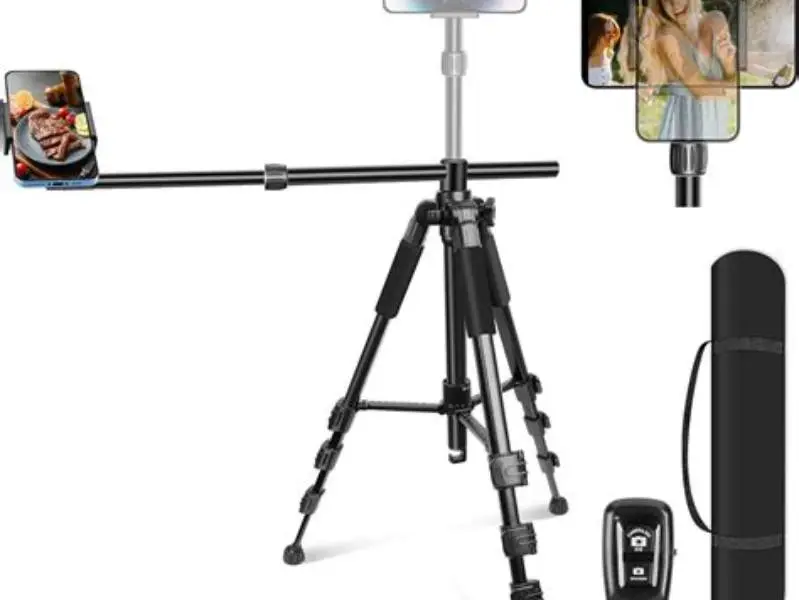
Get an aluminium photo tripod with a rated load of at least 5 kg, a hook on the column for your gym bag, and a clamped phone mount. Film deadlifts from 45 degrees at shin height, around 2.5 metres out, at 120 fps.
On this page (9 sections)
- Fit check
- Remember this
- Why 120 fps is usually enough for deadlift form
- The best phone tripod for filming deadlifts at 120 fps
- Where to put the tripod for a deadlift: angle, height and distance
- Bench press at 240 fps: placement that avoids the rack
- Clamps versus MagSafe: keeping the phone on the tripod
- When a tripod is impractical: rack and magnetic alternatives
- FAQ
Part of the guide: Clamping a phone on a 32mm squat rack bar: jaw width, pads, and tethers

Keeps your phone frame steady when plates hit the platform - its 8 kg load rating is built for far heavier
Check it on Amazon
NEEWER BASICS 74" Video Tripod with Fluid Head
If you pan between the rack and the platform mid-set, the fluid head gives you smooth tilts for bar-path
See this alternative
K&F CONCEPT 80" Video Tripod with Fluid Head
For coaches shooting high-angle squat footage and deadlifts off the same legs, the 2 m height plus a 17.6 lb
See the heavy-duty one| Product | tripod rated load (kg) | Verdict | |
|---|---|---|---|
| NEEWER 79"/200cm Video Tripod NEEWER | Rated load 8 kg vs the 5 kg floor it needs to beat | Meets it | View on Amazon |
| NEEWER BASICS 74" Video Tripod with Fluid Head NEEWER | Rated load 17.6 lb = 7.98 kg vs the 5 kg floor; 73 mm bowl and mid-level spreader as specified | Meets it | View on Amazon |
| K&F CONCEPT 80" Video Tripod with Fluid Head K&F CONCEPT | Rated load 17.6 lb = 7.98 kg vs the 8 kg upgrade bar and 79.5 in (2.02 m) height vs 1.6 m | Meets it | View on Amazon |
| K&F CONCEPT 73" Camera Tripod with Fluid Head K&F CONCEPT | Rated load 6.6 lb = 3.0 kg, below the 5 kg floor; tripod weight 3.13 lb = 1.42 kg, below the 2.5 kg fallback | Short by 40% | View on Amazon |
Fast facts
- Frame rate for form
- 120 fps
- Use 240 fps for
- bar whip, fast lockout
- Minimum load rating
- 5 kg
- Deadlift camera height
- shin height, about 25 cm
- Deadlift distance
- 2 to 3 metres, 45 degrees
- Bench tripod height
- below bench seat level
- Column ballast
- about 5 kg bag
Remember this
- 120 fps is enough to review deadlift form; save 240 fps for bar whip and lockout detail
- Choose a head and legs rated for 5 kg or more: light travel tripods wobble when plates hit the floor
- Hang your gym bag on the column hook; 5 kg of ballast kills residual vibration
- Deadlifts: 45-degree side view, lens at shin height, 2 to 3 metres back
- Bench at 240 fps: tripod below bench height, lens just inside the upright line
- Use a clamp mount, not MagSafe, when plates are being dropped near the camera
Why 120 fps is usually enough for deadlift form
At 120 fps you get one frame every 8.3 milliseconds. A deadlift bar moving at one metre per second (typical for a working-weight pull) travels a little over 8 mm between frames. That is plenty to see whether the bar drifts forward off the floor, whether your hips shoot up early, and whether your back angle holds. Almost every form fault worth fixing shows up clearly at this rate.
Frame rate is not the same as shutter speed, and this is where bad footage usually comes from. Phones shoot 120 fps with a short exposure per frame, so motion blur is low and every wobble in the camera is recorded faithfully. A tripod that looked fine at 30 fps suddenly shows a faint shimmer on every frame. The camera became honest, and the tripod has to become honest too.
Where 240 fps earns its place is the fast end of the lift. A heavy single moving at two metres per second covers 17 mm per frame at 120 fps, and a bar under whip during a bounce-style deadlift can move faster still. If you are diagnosing bar whip, grippy bounce off the floor, or a snatch-grip speed pull, 240 fps doubles your sample rate. For a conventional pull you are reviewing for technique, it mostly doubles file size.
The best phone tripod for filming deadlifts at 120 fps
The fix is an aluminium photo tripod with a rated load of at least 5 kg, flip-lock or twist-lock legs that spread wide, a hook under the centre column, and a clamped phone mount on top. That combination clears every constraint slow motion imposes. Sellers print the load rating in the bullet points, so it is the one figure you can actually shop on. If that sounds like your situation, read up on 15mm rod clamp mount problems next.
Why 5 kg when your phone weighs a fifth of a kilo? Because the rating is a proxy for stiffness. A head and column built to hold 5 kg of camera barely flex when a plate drop sends a vibration pulse through the floor. A head built for 1 kg flexes and rings, and at 120 fps that ringing sits inside your frame, right around the moment the bar lands. The number is not about weight; it is about how much the head resists moving at all.
The hook matters nearly as much. Hang your gym bag off the column and you add 5 to 10 kg of ballast, which damps the residual sway that legs alone cannot. Wide leg spread lowers the centre of gravity and shortens the lever arm any floor vibration acts through. Together, load rating and ballast are what separate a tripod that films deadlifts cleanly from one that films them shakily.
| Spec | Weak for the gym | Strong for the gym |
|---|---|---|
| Rated load | 1 to 3 kg | 5 kg or more |
| Tripod weight | under 1.5 kg | 2.5 kg or more |
| Column hook | absent | present, take a 5 kg bag |
| Leg locks | thin twist locks | flip locks, wide spread |
| Phone attachment | bare MagSafe | clamp with 1/4-inch thread |
- holds frames clean through plate drops
- bag hook adds free ballast
- load rating is printed on every listing
- works for squats and bench too
- heavier to carry than a travel pod
- tallest options crowd tight home gyms
NEEWER 79"/200cm Video Tripod
Keeps your phone frame steady when plates hit the platform - its 8 kg load rating is built for far heavier cameras, so floor vibration won't make the legs ring.
- Size 200cm
- Weight 12.43 lb
- Length 7.9 inches
Where to put the tripod for a deadlift: angle, height and distance
Bar path is a side-on measurement, so the camera must see the plate from the side. Pure 90-degree side view works, but 45 degrees is better in a busy gym: it keeps the bar fully visible while letting you see hip extension too, and it puts the camera out of the lifting lane. Set the tripod behind and to the side of the bar, on the 45-degree line. It helps to understand camera mounting guide before going further.
Height is the detail most people get wrong. The bar starts at about 22 cm for a standard plate and finishes at hip height, so the interesting motion happens low. Put the phone lens at roughly shin height, 25 to 30 cm off the floor, and the bar travels through the middle of the frame where tracking is easiest. A tripod shot from standing eye height compresses the pull and hides the first pull off the floor entirely.
Distance follows from the lens. At the main wide camera, roughly 65 degrees of horizontal field of view, you need to be far enough back that a 1.6 to 1.8 metre pull plus headroom fits vertically in the frame: about 2 metres for most phones held in portrait. If you film at 2x, roughly 26 degrees of view, you need around 4 metres to keep the full pull in frame, and you gain the tighter framing that makes bar drift obvious.
| Lens | Field of view | Minimum distance | Bar drift visible? |
|---|---|---|---|
| 1x wide | about 65° | about 2.0 m | mildly |
| 2x | about 26° | about 4.0 m | clearly |
| 0.5x ultra-wide | about 120° | about 1.2 m | poorly, heavy distortion |
NEEWER BASICS 74" Video Tripod with Fluid Head
If you pan between the rack and the platform mid-set, the fluid head gives you smooth tilts for bar-path checks, and the 17.6 lb rating means deadlift vibration barely registers.
- Weight 9.44 lb
- Length 6.3 inches
- Width 6.3 inches
At 120 fps the tripod, not the phone, decides whether your bar path is readable — and that comes down to one number on the head's spec sheet.
Bench press at 240 fps: placement that avoids the rack
Bench changes the placement problem because the rack uprights sit between the camera and the bar. Shoot from the side at 45 degrees again, but push the tripod further out (3 to 4 metres) so the upright on the near side no longer occludes the bar through the press. At that distance use the 2x lens to recover framing, which also makes 240 fps worthwhile: lockout speed and elbow flare are exactly the fast motion slow motion is for.
Get the tripod lower than the bench. With the lens below bench seat height, looking very slightly up, the bar's path over the chest reads cleanly and the lifter's elbow angle is visible. At standing height the bar hides behind the chest at the bottom of every rep, which is the part you most want to see at 240 fps.
One caution for 240 fps specifically: light drops. Many phones force a very short shutter at 240 fps, so vibration from a controlled bar return still registers frame by frame. The same 5 kg-rated head and hooked bag apply. If your platform is shared and someone is deadlifting nearby, the vibration arrives through the floor to your bench tripod too.
K&F CONCEPT 80" Video Tripod with Fluid Head
For coaches shooting high-angle squat footage and deadlifts off the same legs, the 2 m height plus a 17.6 lb load rating covers both with room to spare.
- Size 80 inch
- Weight 12.35 lb
Clamps versus MagSafe: keeping the phone on the tripod
A dropped bar is a shock event, and shock events test the phone mount. A spring clamp that wraps the phone's corners holds through vibration in every direction. A MagSafe ring resists a steady pull of roughly a kilogram or so, but a sharp jolt through the tripod can make the phone rotate on the magnet ring: enough to swing your carefully aimed 45-degree angle off by several degrees between sets.
Magnets are fine for static mounting on a rack or machine, where nothing nearby is being dropped. For free-standing tripods on a lifting platform, use a clamp with a 1/4-inch thread into the head, or a MagSafe mount that also engages a clamp or screw for security. The vibration risk is rotation and drift, not usually a phone flying off, but a drifted angle ruins the bar-path video you stood there for.
Whichever mount you choose, check it after the first heavy session. If the phone angle has shifted, the mount is losing the argument with your gym floor, and a clamp is the answer.
- clamps survive shock and rotation
- MagSafe pairs nicely with static rack mounts
- 1/4-inch thread fits any head
- clamps are slower to mount
- some clamps block buttons or charging
When a tripod is impractical: rack and magnetic alternatives
Some gyms will not let you set legs on the platform, and some home setups have no floor space to spare. A rack-mounted phone mount that clamps to an upright solves both, and it has a real advantage: the rack is bolted to heavy steel, so the camera is steadier than most tripods during drops. The trade-off is fixed placement: you get the height the rack gives you, and a 90-degree side view rather than 45 degrees unless the rack sits at an angle to the platform.
Magnetic mounts on any steel surface (plate-loaded machines, squat stand uprights, even a heavy plate leaning against the wall) are the fastest option and the least secure. They work well for static 30 fps clips and for bench, where you can place them on the frame of the bench itself. They are the wrong tool for the platform edge during heavy deadlifts, for the rotation reasons above.
The honest ordering for 120 fps deadlift work: clamped rack mount first if placement works, then a tripod with ballast, then magnets for everything low-stakes. Stability beats convenience when the whole point of the footage is measuring bar path.
| Option | Stability through drops | Placement freedom | Best for |
|---|---|---|---|
| Clamped rack mount | excellent | low, fixed to rack | shared gym platforms |
| Tripod plus ballast | very good | full 45-degree control | most lifters, best footage |
| Magnetic mount | fair, can rotate | anywhere steel | quick clips, bench setup |
- rack mounts need no floor space
- magnets set up in seconds
- rack steel damps vibration well
- rack height is not adjustable
- magnetic mounts rotate under shock
- tripods are banned on some platforms
A heavy aluminium tripod with a 5 kg-rated head, a column hook and a clamped mount is the right tool for 120 fps deadlift filming; lighter travel pods are the popular choice that fails.
FAQ
Is 240 fps ever worth it for deadlifts?
For reviewing technique on a conventional pull, 120 fps already captures every fault. Switch to 240 fps when the bar is moving fast (heavy singles, whip on a flexible bar, or bounce off the floor) because that is when 8 ms between frames starts missing detail.
Why does my 120 fps video look shaky even on a tripod?
Slow motion records the camera's own vibration faithfully because the shutter is fast. A light tripod or flimsy head rings when plates hit the floor. A head rated for 5 kg plus a bag hung on the column removes almost all of it.
Can I use a Gorillapod-style flexible tripod?
It will hold the phone, but it cannot take a column ballast and its legs flex, so it fails the stiffness test at 120 fps. Fine for static 30 fps clips, not for measuring bar path.
How far back should the camera be?
About 2 metres on the main wide lens in portrait, or around 4 metres if you film at 2x. Both keep a full 1.7 metre pull plus headroom in frame; the 2x version shows bar drift much more clearly.
Will a magnetic mount really come loose?
It rarely detaches entirely, but a dropped bar's shock through the tripod or rack can rotate the phone on the ring, which swings your 45-degree angle off. For platform work use a clamp, or a magnet with a secondary clamp or screw lock.
Do I need a fluid head for filming lifts?
No. A stiff ball or 3-way head is enough because the camera sits still during a rep. A fluid head only pays off if you pan between lifters or want smooth reframing while filming longer sessions.