How loudspeaker magnets make sound by moving the speaker cone

Loudspeakers use permanent magnets and electromagnets to move the speaker cone. Electrical signals create a magnetic field in the coil. This interacts with the permanent magnet, pushing and pulling the cone to produce sound waves.
On this page (8 sections)
Part of our guide on magnetic mounts and overheating
Fast facts
- Permanent magnet type
- Usually ferrite or neodymium
- Voice coil length
- Typically 10-30 mm
- Cone movement range
- A few millimeters
- Sound frequency range
- 20 Hz to 20 kHz
- Magnetic field strength
- 0.3-1 Tesla typical
Remember this
- Permanent magnets provide a stable magnetic field
- Electromagnets in coils respond to audio signals
- Magnetic forces move the speaker cone back and forth
- The cone movement creates air pressure waves heard as sound
- Magnets are essential for converting electrical signals into sound
Why magnets are used in speakers
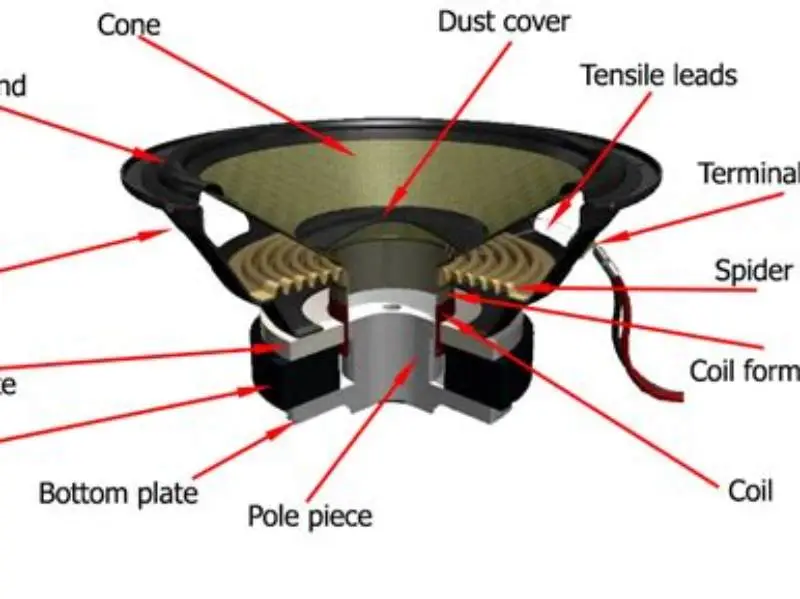
Magnets provide the steady magnetic field that voice coils push against. That steady field lets electrical signals become mechanical motion. The coil sits in a narrow gap inside this field and moves when current flows. Movement drives the cone and makes pressure waves you hear.
Sound output requires a constant reference field. A changing coil field alone cannot produce net motion without something fixed to push against. A permanent magnet supplies that fixed field. Choose stronger magnets for higher efficiency. Stronger magnets let the speaker deliver more sound for the same electrical input.
Magnet shape controls how uniform the gap field is. Ring-shaped magnets concentrate flux into a cylindrical gap. A uniform field makes the coil force linear across its travel. Linear force reduces harmonic distortion and keeps frequency response smooth.
Magnets differ by material and aging. Ferrite magnets are cheap and stable but heavy. Neodymium magnets are lighter and keep strength longer. If a magnet weakens, expect lower sensitivity and less volume at the same amplifier power. Check magnet pull with a small metal object to spot a big drop in strength. We go through phone wallet mount neodymium magnets source step by step elsewhere on the site.
How electromagnets work inside loudspeakers
A voice coil is a wound conductor attached to the cone. When audio current flows, the coil becomes an electromagnet. Polarity flips with the waveform. That alternating field interacts with the permanent magnet’s fixed field and creates a force.
Opposite poles attract and like poles repel. This push-pull force moves the coil along the speaker axis. Movement tracks the audio signal’s frequency and amplitude. Low frequencies move the cone farther. High frequencies move it back and forth quickly but over smaller distances.
Designers balance coil mass, turns and resistance. Lighter coils respond faster and extend high-frequency output. More turns increase the coil’s magnetic strength but raise resistance and mass. Typical household speakers run at 4 or 8 ohms. Pro speakers sometimes use lower impedances for higher power transfer. People in this spot often ask about does magnetic phone holder affect battery as well.
Heat is the usual failure point. Current produces heat in the copper or aluminum winding. Overheat it and insulation melts, causing a short. Use ventilation, heat-resistant formers, or ferrofluid in the gap to carry heat away. Measure coil resistance with a multimeter; a big change signals damage.
The role of permanent magnets in speaker function
Permanent magnets provide the stable magnetic field that the voice coil needs to interact with. Usually, ferrite or neodymium magnets are used depending on cost and performance requirements.
Neodymium magnets are smaller and stronger, allowing compact speaker designs with higher magnetic flux density. Ferrite magnets are heavier and cheaper but still effective for many applications. Before you commit to anything, it is worth looking at magnetic phone mounts and data safety.
The magnetic gap between the magnet and coil is precisely engineered. A narrow gap concentrates the magnetic field, increasing efficiency and sensitivity. The gap width is usually a fraction of a millimeter.
Magnet strength affects the speaker’s maximum power and sound clarity. A stronger magnet can move the cone more precisely at higher volumes without distortion.
Magnet grade is a critical factor. Neodymium magnets have grades like N35 to N52, where higher numbers mean stronger magnets. Speakers with N52 magnets typically produce clearer sound at higher volumes.
The air gap’s length affects the magnetic flux density. A shorter gap means a stronger concentrated field but requires very precise manufacturing. Even a 0.1 mm change can affect sound performance noticeably.
Manufacturers sometimes coat magnets to prevent corrosion. Ferrite magnets are porous and can degrade in moist environments, while neodymium magnets are coated in nickel or epoxy. Corroded magnets reduce field strength and cause speaker deterioration.
Magnets in loudspeakers work with coils to push cones and create sound in a direct, physical way few explain clearly.
Why speakers need magnets
Speakers need magnets to convert electrical signals into mechanical motion. The audio signal itself is electrical and inaudible. Magnets transform this electrical energy into movement.
This movement vibrates the cone, pushing and pulling air to create sound waves. Without magnets, the electrical signal would remain static and silent.
Magnets also influence speaker sensitivity, efficiency, and distortion levels. A well-designed magnetic system reduces energy waste and improves sound fidelity.
The magnet and coil must be matched for optimum performance. Mismatched components cause weak sound or damage from overheating.
Speakers also need magnets to maintain linear cone movement. The constant magnetic field ensures the coil moves back and forth smoothly without sticking or drifting.
If the magnet is too weak, the coil may not respond fully to the electrical signal, causing muffled or distorted sound. If too strong, it can cause excessive force and damage the coil or cone over time.
Matching coil impedance and magnet strength is vital for good speaker design. A mismatch can cause inefficient power use or overheating. Measuring impedance with a multimeter helps verify suitability.
How are magnets used in loudspeakers
Magnets are central to loudspeaker operation. The permanent magnet creates a constant magnetic field in the speaker’s gap. The voice coil acts as an electromagnet by carrying an electrical signal that changes its magnetic polarity.
This changing polarity causes magnetic forces between the coil and permanent magnet. These forces push and pull the coil and attached cone. The cone movement matches the waveform of the audio signal, reproducing sound.
The magnet does not create sound directly but enables the coil’s magnetic field to produce mechanical vibration. This interaction is the basis for all dynamic loudspeakers.
The size, strength, and type of magnet affect power handling, efficiency, and sound quality. High-quality speakers use strong neodymium magnets to reduce weight and improve performance.
Magnetic flux density in the gap often ranges from 0.5 to 1.2 Tesla in quality speakers. This strong field allows the voice coil to produce precise and loud sound with minimal distortion.
The coil’s movement amplitude is tiny but rapid. It might move only fractions of a millimeter at high frequencies but does so thousands of times per second, producing sound waves you can hear.
If the magnet or coil is damaged, the cone movement becomes erratic or limited, causing distortion or no sound. A simple test is to gently push the cone by hand; it should move smoothly without scraping or stiffness.
Do magnetic mounts or wallets damage phones
Magnetic mounts and wallets use magnets similar in strength to speaker magnets but usually weaker. Modern phones have shielding and design features to protect sensitive components from magnet interference.
The main concern is if magnets affect the phone’s compass or wireless charging. Magnets near the compass sensor can temporarily disrupt orientation readings. This effect is reversible once the magnet is removed.
Wireless charging uses electromagnetic induction that can be disturbed by strong magnets or metal cases. Mounts designed for MagSafe or Qi charging minimize this by placing magnets strategically.
Typical magnetic mounts or wallets do not damage phones. They cause minor, temporary interference if any. For safety, avoid placing very strong magnets directly on phone components or screen.
Speakers rely fundamentally on magnets to function; knowing their role helps avoid damage and improves equipment choices.
FAQ
Can a magnet damage my phone’s screen or data?
Most phone screens and data storage are not affected by magnetic fields from typical mounts or wallets. Modern solid-state drives and LCD or OLED screens have no moving parts sensitive to magnets.
Why do some phones lose compass accuracy near magnets?
Magnets interfere with the phone’s magnetometer used for compass functions. This causes temporary incorrect readings that return to normal after moving away from the magnet.
How strong are the magnets in loudspeakers compared to magnetic mounts?
Speaker magnets often have field strengths around 0.3-1 Tesla, stronger than most magnetic mounts. Mount magnets are designed to hold securely but remain safe for phones.
Does the magnet type affect loudspeaker sound quality?
Yes, neodymium magnets provide higher flux density and lighter weight, improving sound clarity and power handling compared to ferrite magnets.
Can I test my speaker’s magnet strength at home?
You can use a gauss meter to measure the magnetic field strength. This helps verify if the magnet is intact and performing as expected.