How magnetic phone rings hold and charge phones through cases

Magnetic phone rings attach via adhesive and align with phone magnets or metal parts to hold and support wireless charging through cases up to about 3-5 mm thick, but hold strength and charging efficiency drop as case thickness or misalignment increase.
On this page (8 sections)
- Remember this
- How magnetic phone rings attach and stay on phones
- How the magnets interact with phone and case materials
- If and how magnetic rings support wireless charging
- Why ring placement and phone case thickness affect hold strength
- How magnetic phone rings work
- If magnetic phone rings will hold your phone before buying
- FAQ
Part of our guide on testing phone attachment on squat rack
Fast facts
- Adhesive strength
- up to 5 N/cm²
- Effective case thickness
- 3-5 mm
- Typical magnet pull force
- 0.3-1.2 kgf
- Wireless charge support
- yes, if aligned
- Magnet material
- rare earth (NdFeB)
Remember this
- Magnetic rings stick with strong adhesive to phone case or device surface.
- Hold strength depends on magnet quality, alignment, and case thickness.
- Wireless charging works best when ring magnets align with phone magnets.
- Cases thicker than 3-5 mm weaken magnetic hold and charging efficiency.
- Proper ring placement avoids charging interference and loss of grip.
How magnetic phone rings attach and stay on phones
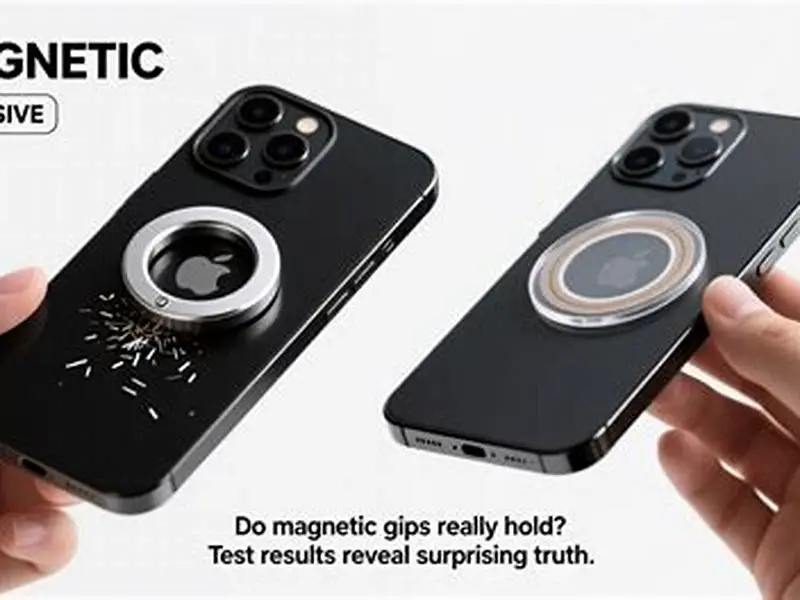
Magnetic phone rings adhere to the phone or phone case surface using a pressure-sensitive adhesive. This adhesive usually has a shear strength around 4-5 newtons per square centimeter under optimal conditions; it must be applied to a clean, flat surface for reliable hold over months of use.
The ring itself contains a rare-earth magnet, often neodymium, embedded in plastic or metal housing. This magnet provides the grip force needed to hold the phone onto compatible mounts or prevent drops when used as a finger grip. The adhesive’s strength and the magnet’s pull force together determine the overall attachment stability.
Over time, dirt, heat, or oils from handling can reduce adhesive effectiveness, so surface cleanliness is critical before placement. Rings placed directly on the phone backplate usually hold better than those on thick or textured cases, where surface irregularities reduce adhesive contact area.
How the magnets interact with phone and case materials
Magnetic phone rings work by interacting magnetically with either built-in magnets inside the phone (such as MagSafe arrays) or metal plates embedded in mounts or cases. Rare-earth magnets produce a magnetic field strong enough to attract ferromagnetic metals typically used in phone mount components. We cover are magnetic phone chargers safe in its own article.
Phone cases made from non-metallic materials like plastic, silicone, or leather do not interfere with the magnetic field but add physical distance between the ring and the phone or mount magnets. This distance weakens magnetic pull exponentially with thickness.
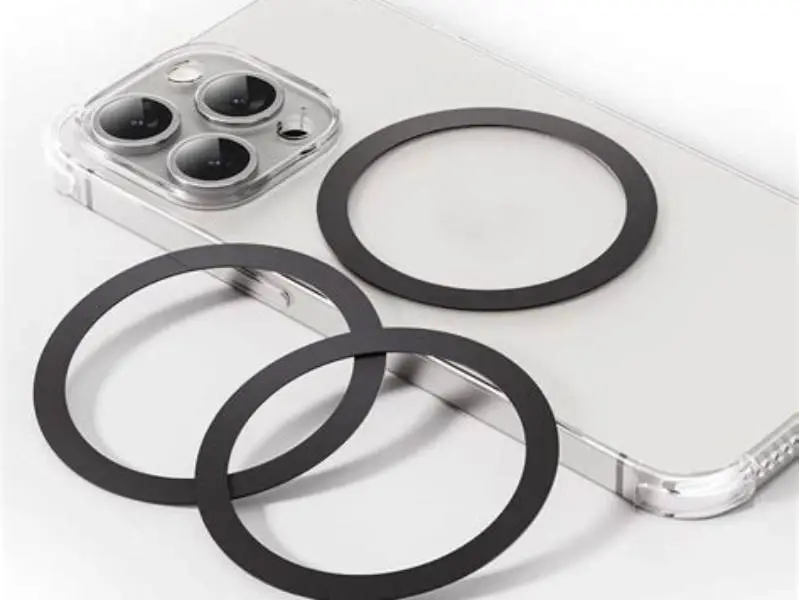
Metal cases or cases with embedded metal plates can disrupt or augment the magnetic field. Steel plates attract the ring magnet, increasing hold strength but may block wireless charging. Aluminum cases block magnetic fields less but still add thickness that reduces overall grip.
| Material | Magnetic Interference | Effect on Hold | Effect on Charging |
|---|---|---|---|
| Plastic/silicone/leather | None | Reduced by thickness | Minimal |
| Aluminum | Low | Reduced by thickness | Minor |
| Steel/ferromagnetic metal | High | Hold increased | Charging blocked |
| Cases with metal plates | Variable | Hold increased | Charging blocked |

Digital Caliper Measuring Tool
Measures thickness with accuracy ±0.02 mm, precise enough for phone case thickness affecting magnetic hold.
If and how magnetic rings support wireless charging
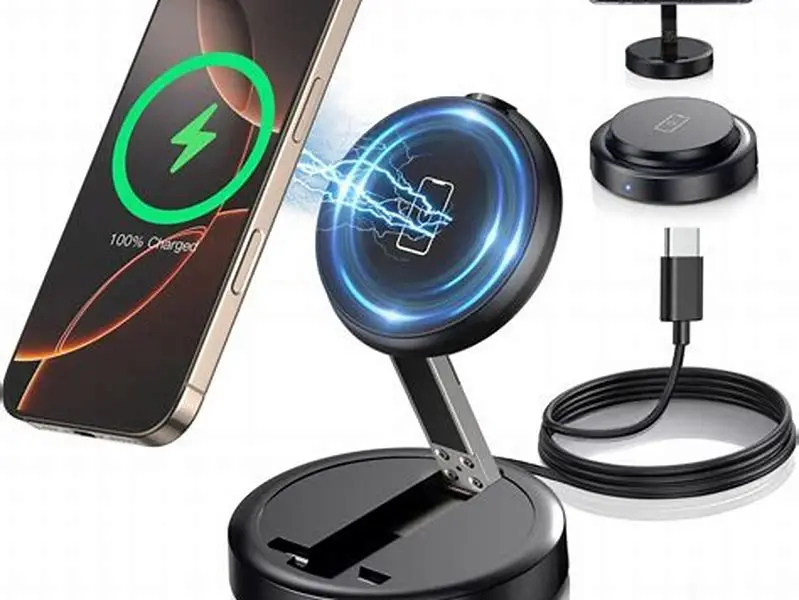
Wireless charging uses electromagnetic induction, requiring alignment between the phone’s charging coil and the charging pad. Magnetic rings can support wireless charging only if their magnets align with the phone’s internal magnetic array and do not block the coils. The other half of this decision is qi2 magnets with magsafe accessories.
When the ring magnet overlaps or is very close to the charging coil, it can interfere by blocking or detuning the coil’s electromagnetic field, resulting in slower or no charging. This interference is common if the ring is off-center or large.
MagSafe-compatible rings are designed to align precisely with the phone’s magnetic array, allowing simultaneous charging and magnetic hold. Thicker rings or poorly placed rings reduce charging efficiency significantly.
Wireless charging efficiency drops by 10-20% or more if any metal or magnetic object is between the charging pad and phone coil, so thinner rings and cases improve results. People in this spot often ask about adhesive ring mount for 2.5 mm leather case as well.
Magnetic phone rings hold and charge phones through cases only when ring placement, case thickness, and magnet strength align correctly.
Why ring placement and phone case thickness affect hold strength
Magnetic hold strength depends heavily on how close the magnet in the ring stays to the phone’s internal magnets or the mounting surface. Each millimeter of extra case thickness reduces magnetic pull force by roughly 10-20%, so cases thicker than 5 mm usually prevent secure hold.
Ring placement matters because phone magnets are typically located centrally on the back. Placing rings off-center shifts the magnetic field away from the phone magnets, weakening the grip if the ring relies on the phone’s internal magnets.
Placing a metal plate inside or behind the phone case can boost hold strength but risks blocking wireless charging and adds bulk, changing how the phone fits in mounts or pockets.
Using a thinner case or one designed with magnetic windows enhances hold and charging but may sacrifice drop protection or aesthetics.
| Case Thickness (mm) | Hold Strength (%) | Charging Efficiency (%) | Recommended Ring Placement |
|---|---|---|---|
| 1-3 | 80-100 | 90-100 | Centered over phone magnets |
| 3-5 | 50-80 | 70-90 | Centered or with metal plate |
| 5-7 | 20-50 | 40-70 | Metal plate recommended |
| >7 | 0-20 | 0-40 | Not recommended |
How magnetic phone rings work
Magnetic phone rings operate by combining a strong rare-earth magnet with an adhesive base that sticks to the phone or its case. The magnet generates a magnetic field that adheres to compatible metal surfaces or phone magnets, creating a secure grip.
The phone’s internal magnets, common in MagSafe-compatible devices, are arranged in a ring pattern matching the magnetic ring accessory. When aligned, these magnets lock together, providing both physical hold and electrical alignment for wireless charging.
If the phone lacks internal magnets, magnetic rings rely on embedded metal plates in cases or mounts. The magnetic attraction strength depends on magnet size, grade (usually N42 to N52 neodymium), and the distance caused by the case.
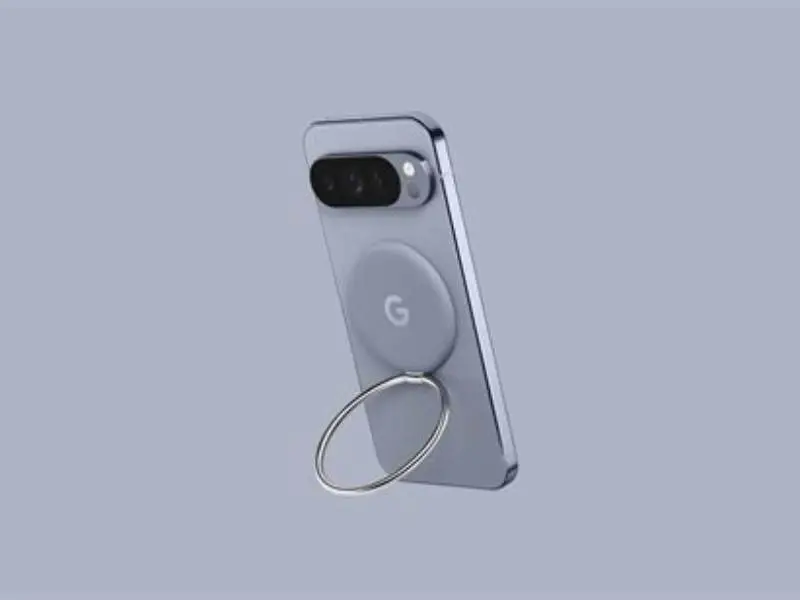
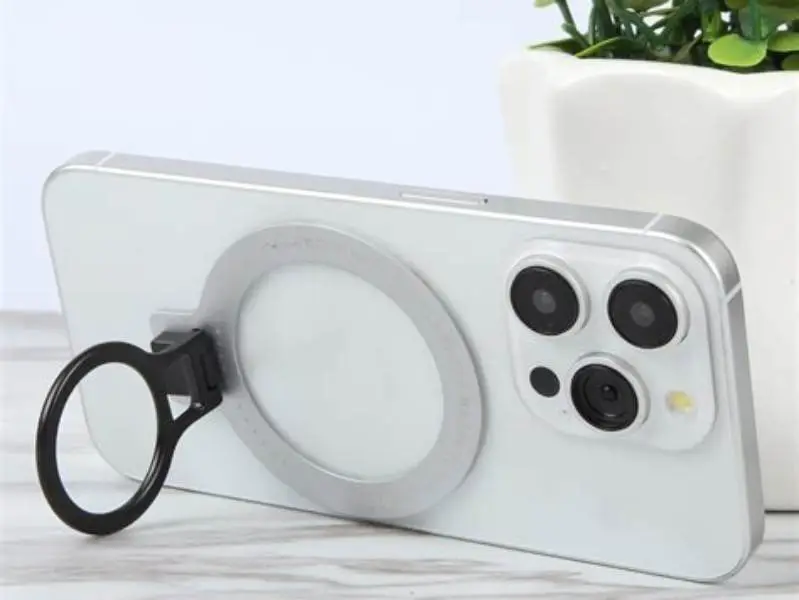
The ring’s design often includes a finger loop or stand feature, enhancing grip and convenience. While this is a mechanical benefit, the magnetic hold provides the core attachment force.
If magnetic phone rings will hold your phone before buying
To judge if a magnetic phone ring will hold your phone and case depends on your case thickness, material, and phone model. Measure your case thickness with a digital caliper; values under 5 mm are usually safe for magnetic hold.
Check if your phone is MagSafe or Qi2 compatible with built-in magnets, as rings designed for these technologies hold and charge best. If not, verify if your case includes a metal plate or if you can add one without blocking charging.
Test the pull force by using a small neodymium magnet similar to phone ring magnets to see how it attracts your phone or case. A pull force around 0.3 to 1.0 kilogram-force indicates likely effective hold.
Be aware that even a strong magnetic ring can fail on very thick, metallic, or heavily textured cases. If unsure, consider a ring with adjustable placement or magnetic mount compatibility information.
- Measure your phone case thickness with a caliper.
- Confirm your phone model supports MagSafe or Qi2 magnets.
- Check case material and presence of metal plates.
- Test magnetic attraction with a neodymium magnet.
- Choose a magnetic ring designed for your phone and case profile.
FAQ
Can magnetic phone rings damage my phone or data?
No, modern phones and magnetic rings use magnets that do not affect data storage or screens. However, very strong magnets placed near magnetic sensors might cause calibration issues on rare occasions.
Will a magnetic ring work with any phone case?
Magnetic rings generally work best on thin plastic or silicone cases under 5 mm thick. Thick or metal cases reduce hold strength and can interfere with wireless charging.
Do magnetic phone rings interfere with credit cards or other devices?
Magnetic rings rarely affect credit cards if not placed near them. Keep credit cards away from magnets as a precaution, but phone rings typically pose no risk to other electronics.
Can I use a magnetic phone ring and a wireless charger simultaneously?
Yes, if the ring is designed for MagSafe or Qi2 and properly aligned. Otherwise, the ring can block or slow wireless charging.
How long does the adhesive on a magnetic ring last?
Adhesive typically lasts months to years under normal conditions but weakens with heat, moisture, and repeated removal.