Smith machine bar weight: 45 lb or 30 lb, and how to check

Most Smith machine bars weigh 45 lb (20 kg) or 30 lb (13.6 kg), with 25 lb (11 kg) bars showing up on lighter machines. Read the stamp on the sleeve or collar to know which one you have, and if the stamp is gone, weigh the bar or check the machine's spec label before you log a single set.
On this page (8 sections)
Part of our guide on phone mount for spin bike handlebars
Fast facts
- Standard Bar Weight
- 45 lb (20 kg)
- Lighter Option
- 30 lb (13.6 kg)
- Full Range
- 25 lb to 45 lb (11 to 20 kg)
- Weight Location
- Stamped on sleeve end or collar
Remember this
- Smith machine bars fall between 25 lb (11 kg) and 45 lb (20 kg). The 45 lb and 30 lb bars cover almost every machine in a commercial gym.
- The weight is stamped on the sleeve end or collar. Marks such as '700' or 'T300' are steel tensile ratings, not the weight of the bar.
- On the same plate load, a 30 lb bar gives you 15 lb less than a 45 lb bar. On a 225 lb set that gap is about 7 percent.
- Angled Smith machines use a cam, so the resistance you feel at midrange does not match bar plus plates. Vertical rail machines track a free barbell much more closely.
- Unknowable bar weight is the quiet problem. A 15 lb error in your log looks like a bad week of training when it was never a bad week.
Bar weights: 25 lb to 45 lb across the range
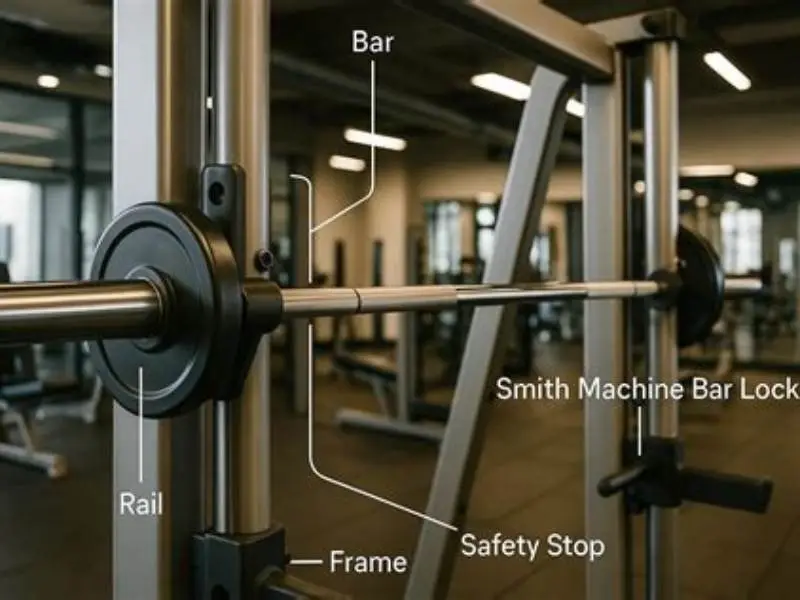
Smith machine bars sit in a narrow band. They weigh somewhere between 25 lb and 45 lb, and the two you meet most often are the 30 lb (13.6 kg) commercial bar and the 45 lb (20.4 kg) Olympic bar.
A Smith built into a rack or bolted into a strength machine usually runs the short 30 lb bar. Free-standing Smiths built around an Olympic frame often take a full 45 lb bar with1.49 in (37 mm) sleeves.
Some lighter units use a 25 lb (11.3 kg) bar for people who want less resistance at the bottom. A handful of older machines use a hollow steel bar in the 15 to 20 lb (7 to 9 kg) range.
So the answer to how much a Smith machine bar weighs depends on which machine you are standing in front of. Check the stamp before you assume it matches the free barbells in the next rack. There is more on metal plate phone case for bike mount in a separate guide.
| Bar type | Weight (lb) | Weight (kg) | Where you find it |
|---|---|---|---|
| Olympic bar | 45 | 20.4 | Free-standing Smiths with a full 2.2 m (7 ft 2 in) bar |
| Commercial bar | 30 | 13.6 | Machines built into a rack or a strength frame |
| Light bar | 25 | 11.3 | Lighter machines and older rehab units |
| Hollow bar | 15 to 20 | 7 to 9 | Rare, usually older specialty machines |
Where the weight is stamped
Every steel bar carries its mass somewhere in the metal. Look at the very end of the sleeve, or at the collar of the sleeve, for raised or engraved digits.
Imperial bars read 45 LB or 30 LB. Metric bars read 20 KG or 13.6 KG. A 20 KG stamp means the same 45 lb bar, because 20 kg comes to 44.1 lb and the trade rounds up.
Watch for numbers that are not weight. Stamps such as 700, 800 or T300 refer to the tensile strength of the steel, not the mass of the bar. Those marks often sit right beside the weight on the same face of the sleeve. The other half of this decision is fitting mounts on smith machine uprights.
Finish matters here. Black oxide, raw steel and zinc-plated bars all come in both 45 lb and 30 lb, so the colour of the sleeve tells you nothing about the mass.
| Stamp | What it tells you |
|---|---|
| 45 LB | The bar weighs 45 lb (20.4 kg) |
| 30 LB | The bar weighs 30 lb (13.6 kg) |
| 20 KG | The bar weighs 45 lb, the Olympic standard |
| 13.6 KG | The bar weighs 30 lb (13.6 kg) |
| 700 / T300 | Steel tensile rating, not the bar weight |
Weighing a bar when the stamp is gone
Stamps wear off. Decals peel, paint gets sanded away in a busy gym, and two machines from the same batch can end up looking different.
Start with the machine itself. Every commercial unit has a model number and a spec label somewhere on the frame or carriage. Look up the model and the manufacturer lists the bar weight in the manual or on the spec sheet. It helps to understand phone mount for multi-grip pull-up bar before going further.
If the bar bolts out of the carriage, take it off, pull the collars, and weigh it on a platform scale. A45 lb bar and a 30 lb bar are easy to tell apart in your hands if you have lifted both.
If the bar is welded in, you cannot weigh it on its own. Ask the gym staff for the model number, or message the manufacturer with the serial number. They answer these questions faster than most people expect.
Last resort: borrow a known bar. Load the same plates on your free barbell and on the Smith, lift the same number of reps, and compare the feel. That gives you a rough read, not a number, so use it only to place the bar in the right band of 25, 30 or 45 lb. We cover textured wall phone charger solutions in its own article.
- Read the model number on the frame or carriage and look up the spec sheet for the bar weight.
- Check the sleeve end and the collar for a stamped weight in lb or kg.
- If the bar is removable, take it out, remove the collars, and weigh it on a scale.
- If the bar is welded in, confirm the model with the manufacturer or the gym staff.
- Compare against a known bar only to place the weight in the right band, then record it as an estimate.
Worked example: matching a 225 lb free barbell
Here is where the number stops being trivia. A 45 lb bar and a 30 lb bar loaded with identical plates are not the same lift.
On a 45 lb bar, a 225 lb squat is two 45 lb plates, two 25 lb plates and two 2.5 kg plates. That is 195 lb of plates plus a 45 lb bar.
On a 30 lb bar, those same plates give you 175 lb total. To reach 225 lb you need 195 lb of plates, which means adding four 25 lb plates or a pair of 2.5 kg plates on top.
The gap is 15 lb on every set. At 225 lb that is about 7 percent, and it compounds fast across a training block. Your bench goes up in the log while your actual load goes down.
Leave collars out of the comparison if you are matching a free barbell. A pair of collars adds roughly 2 lb to 4 lb, and on a Smith machine most people leave them off entirely.
| Plates loaded | With30 lb bar | With 45 lb bar |
|---|---|---|
| 2 x 45 lb | 120 lb | 135 lb |
| 2 x 45 lb + 2 x 25 lb | 170 lb | 185 lb |
| 2 x 45 lb + 2 x 25 lb + 2 x 5 lb | 180 lb | 195 lb |
| 2 x 45 lb + 2 x 25 lb + 2 x 2.5 kg | 175 lb | 195 lb |
Angled machines and why the total lies
Not every Smith machine matches a free barbell, and this is the part most weight charts leave out.
An angled Smith, the kind in most strength machines, uses a cam. The bar travels on an arc while the carriage moves in a straight line. The bar's own weight contributes less at midrange than the printed number suggests.
Manufacturers publish a weight ratio for these units. Expect the felt resistance to run below the bar plus plate total, sometimes by a wide margin, so the ratio on your spec label is the number to trust. The plates still move one for one, which is why plate math stays useful even when the bar does not.
A vertical rail Smith, the classic post-and-rack design, behaves much closer to a free barbell. The bar stays level and slides straight up, so the bar weight adds in full at every point in the range.
Also check the carriage rating. Smith carriages are commonly rated between 300 lb and 500 lb. Exceed that and you are loading the cam and rails, not just your quads.
| Design | Bar travel | How bar weight counts |
|---|---|---|
| Angled (cam) Smith | Arcs with the carriage | Reduced at midrange, check the published ratio |
| Vertical rail Smith | Straight up, bar stays level | Adds in full, close to a free barbell |
Failure modes: three ways the guess goes wrong
These are the mistakes that quietly distort a training log.
Guessing 45 lb on a 30 lb bar leaves you 15 lb light on every set. You chase a plateau that is really a bookkeeping error. This is the single most common one.
Mixing up kg and lb compounds the error. A 45 lb bar is 20.4 kg, and a20 KG bar is 44.1 lb. Small on its own, but if you add plates in kg on a pound bar the gap widens with every pair you load.
Treating the carriage as separate from the bar is the third. On welded-bar machines the bar and carriage are one welded unit, and the manufacturer counts the whole assembly when it quotes a bar weight. The plates you add on top sit above that figure.
- Guessing 45 lb on a 30 lb bar means every logged set is 15 lb light, roughly 7 percent off a 225 lb lift.
- Mixing kg and lb markings on a bar you assumed was the other standard quietly shifts every plate pair you add.
- Quoting the carriage assembly weight as the bare bar weight makes your working load smaller than the machine's own number.
- Loading past the carriage rating strains the cam and the rails long before you reach a failure on the bar itself.
FAQ: Smith bar weight questions
These are the questions that come up most in gyms and in the comments under Smith machine videos. The short answers are below, and every one of them comes back to the same habit: read the bar, then read the machine.