KAVU Rope Sling: how to adjust and wear it right

Wear the KAVU Rope Sling cross-body with the bag on your back, strap running over the shoulder opposite the zipper side. Adjust it empty, then load it, then re-tighten: the loaded bag sits snug where an empty one cinched tight just rides up and swings.
On this page (8 sections)
Part of the guide: Magnetic gym pouch that will stick to a stainless steel plated machine
Fast facts
- Wear position
- Cross-body, bag on back
- Strap test
- One finger under the strap
- Strap side
- Over the non-zipper shoulder
- Gym use
- Rotate bag to front
- Re-tighten
- Every few weeks of use
- Never do
- Knot the rope strap
Remember this
- Adjust the strap in order: loosen fully, put it on, load the bag, then shorten.
- Back position for walking and hiking, side for crowds, front for gym lifts and travel queues.
- Snug enough that one finger slides under the strap on your chest, not more.
- An empty sling cinched tight is the classic mistake; weight settles it down your back.
- The cotton rope strap relaxes over weeks; re-shorten a few centimetres rather than knotting it.
Adjust the single strap: the order that matters
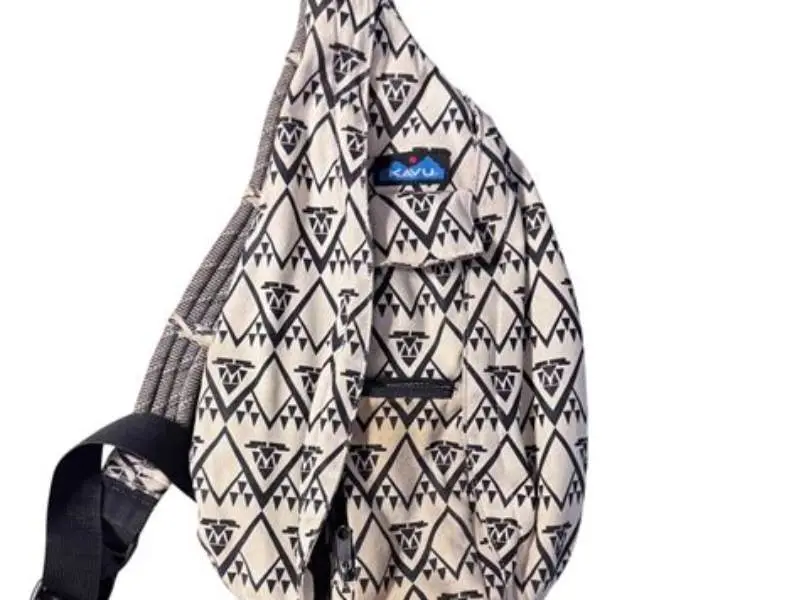
The Rope Sling has one continuous rope strap with a single slider where it meets the bag. Most people fight it because they shorten it first and then try to put it on. Loosening everything is the whole trick, and it takes about thirty seconds once you know the order.
How to wear a KAVU Rope Sling bag comes down to this sequence, and we'd argue the order matters more than the length. Set it loose, get it on your body, put your things in it, then trim the strap. Cotton rope compresses under load, so the length you choose empty is wrong by a couple of centimetres once the bag is full.
The slider holds well when there's tension on it. It slips when the strap is slack, which is exactly what happens if you adjust it on a table and then wear it. Tighten it on your body, with weight inside.
- Slide the adjuster all the way down so the strap is at its longest.
- Put the strap over your head so it runs diagonally across your chest, bag hanging behind your hip.
- Load the bag: phone, keys, bottle, wallet, whatever you actually carry.
- Pull the free end of the strap through the slider until the bag lifts off your hip.
- Test with a shrug and a couple of steps, then trim another centimetre or two if it still swings.
Back, side or front: where the bag should sit
Three positions work, and each one suits a different moment. On your back is the default: the bag sits between your shoulder blades or a little lower, strap running diagonally across your chest. That's the position for walking, hiking, markets, airports, anything where you're moving for more than a few minutes. We go through fitting different bottle sizes step by step elsewhere on the site.
Slide it around to your side under one arm when you're in a crowd or a queue and want eyes on your zip. The bag sits at your hip, half visible. It's less comfortable for long wear because the strap pulls unevenly, but it's the right call on a busy train platform.
Bring it fully around to your chest for gym work, filming, or anywhere you need the contents in front of you. The bag hangs below your chin, and you can open the main zip one-handed. On a machine, that's the difference between reaching behind you and not.
The position isn't set by the strap length alone. Loosen a touch to rotate forward, tighten a touch to send it back. After a week you'll do it without thinking. We go through drawstring gym bag for 32 oz Nalgene step by step elsewhere on the site.
| Position | Best for | Trade-off |
|---|---|---|
| Back | Walking, hiking, all-day carry | Contents out of sight, zip behind you |
| Side hip | Crowds, transit, queues | Uneven pull, less stable over hours |
| Chest front | Gym lifts, filming, travel documents | Bounces if the strap is too loose |

Slider Buckle for 1" Webbing: 4 Set Plastic Ladder Lock Buckles and Tri-glide
Stops your Kavu's slider creeping mid-workout by locking the 25 mm strap in place, with a 120 lb tensile rating so the lock holds under a hard yank.
How tight for walking, hiking and the gym
Snug, not tight. The test we use: one finger slides under the strap across your chest with a little drag. If two fingers fit, it's loose and the bag will swing when you turn. If you can't get a finger in at all, it's pulling on your neck within twenty minutes.
For walking and daily wear, err slightly loose. The bag sits high on your back and you forget it's there. For hiking, tighten one notch: uphill steps and rock hops make a loose bag pendulum, and a pendulum on scree is annoying in a way you don't forget.
In the gym, tightness matters less than position. Pull it forward to your chest before you lift, and cinch it so it can't slide back while you're lying on a bench. A bag sliding off a bench onto a dumbbell is the sound nobody wants to hear.
Height changes with tightness too. A well-set sling rides between your shoulder blades. If it's hanging at your lower back, it's too long, no matter how comfortable it felt in the shop.
| Activity | Strap setting | What tells you it's right |
|---|---|---|
| Daily walking | One finger under strap | Bag rides between shoulder blades |
| Hiking | One notch tighter | No swing when you turn uphill |
| Gym | Cinched, bag at chest | Stays put lying on a bench |
The strap only holds its setting under tension, which is why the sling you adjusted on the table never fits the sling you actually wear.
The overtightening mistake: empty bag vs loaded
Here's the mistake we see constantly, and it's usually a new-owner mistake. You get the sling home, it's empty, you cinch it down so it feels snug against your back, and you lock the strap there. Then you load it. The weight stretches the cotton rope, the bag drops, and now the strap is both too long and digging into your shoulder at the same time.
The rope strap compresses under load by a couple of centimetres. That's not a flaw, it's cotton doing what cotton does. But it means the length you set empty is guaranteed wrong once you put your stuff in.
Two readers, two answers. One carries the sling empty-ish most days: phone, cards, keys. Their setting barely changes between empty and full, so a snug empty fit works. The other stuffs in a bottle and a jacket. They need the two-stage routine: set loose, load, tighten. Same bag, different answer.
So cinch an empty bag only if it will stay nearly empty. Otherwise always make the final adjustment with the load in it.
How the rope strap relaxes, and how to re-tighten it
The soft cotton rope is the reason people love this bag and also the reason it needs maintenance. Over the first few weeks of regular use, the fibres bed in and the strap stretches and thins slightly where it bears weight. A setting that held perfectly in month one will let the bag ride lower by month two.
The fix is simple: shorten the strap back through the slider. Expect to do this two or three times in the first couple of months, then rarely. After the break-in, the rope stabilises and holds its setting for ages.
If the slider itself starts slipping on a well-worn strap, the honest cause is slack and smooth fibre, not a broken buckle. Taking up the tension solves it. Do not knot the rope to fake a shorter length. A knot concentrates wear in one spot and is miserable to undo when you want to reset.
Check the strap where it passes through the slider and the bag's attachment points once in a while. Fraying there is normal and cosmetic; a slide a centimetre of wear past the stitch line is the point where you'd retire the strap. On a well-used sling that takes years.
Keeping it locked during workouts and hikes
Movement is where a badly set sling announces itself. On a treadmill or under a barbell, the two failure modes are swinging and sliding. Swinging happens when the strap is too long, sliding when the strap is too smooth and slack to grip the slider. Both have the same fix: final tension set under load, on your body.
Before a lift, rotate the bag to your chest and take up any last slack. Lying on a bench, gravity pulls the bag toward your face, so a strap set for standing will feel different flat on your back. Cinch it one more notch. Done.
On a hike, the routine is the same at every water stop. Shift the bag forward for scrambling, back for cruising. The rope softens with sweat and rain, and a wet strap grips the slider less, so check tension after you get soaked.
The one thing worth buying if your slider creeps no matter what: a rubberised strap grip or anti-slip strap lock that clamps the rope just past the buckle. It's a couple of grams, costs little, and stops the slow lengthen that ruins a set. Fit it, forget it.
Set the strap loose, load the bag, tighten on your body: do it in that order and the sling rides like it should.
FAQ
Which shoulder should the KAVU Rope Sling strap go over?
Either, but the bag's zipper should face outward when it's on your back, which most people find works with the strap over the shoulder opposite the zip. Try both in a mirror; the bag is ambidextrous in practice.
Why does my Rope Sling keep slipping longer even after I adjust it?
Almost always slack. The slider only grips under tension, so a bag riding low means the strap was set too long or set while empty. Take up tension with the bag loaded and it stops.
Can I shorten the rope strap permanently?
You can trim and re-tie the rope, but we wouldn't. The factory knot sets the minimum length and tying your own risks an uneven pull and faster wear at the knot. Adjusting the slider is reversible and free.
Does the bag fit a water bottle?
The side pocket takes a slim bottle up to roughly a litre in a soft flask; wide rigid bottles fight the pocket. With a bottle in it, load first and tighten after, because the weight changes the strap length noticeably.
How do I wear it so it doesn't swing while running?
You mostly don't: a sling isn't a running pack. Tighten it hard, rotate it to your chest so the bounce is in front of you, and accept some movement. For real running, a waist pack or vest beats it.