Will a MagSafe Wallet in My Leather Case Demagnetize Cards?

No. A MagSafe wallet on a leather case won't demagnetize cards inside the case. The magnet sits 3-5mm away from the cards, and at that distance the field strength drops to 200-400 gauss: well below the 1000 gauss threshold that damages magnetic strips.
On this page (8 sections)
- Remember this
- How strong is the magnet in a MagSafe wallet
- What magnetic force actually damages card strips
- Effect of leather case thickness on magnet strength at card position
- Will a MagSafe wallet in my leather case demagnetize cards inside
- Common user experiences and real-world tests
- Where to keep cards if you're still concerned
- FAQ
Part of our guide on qi2 ring sticker holding pixel 10 pro
Fast facts
- MagSafe wallet field strength
- 600-800 gauss at surface
- Through 3-5mm leather
- 200-400 gauss
- Demagnetization threshold
- 1000+ gauss sustained
- Card position in case
- Opposite side from magnet ring
- Hotel keycard lifespan
- Days to weeks, any pocket
Remember this
- MagSafe wallet magnets measure 600-800 gauss at the surface but drop to 200-400 gauss through a leather case
- Magnetic strips need sustained exposure above 1000 gauss to demagnetize: MagSafe wallets don't reach that through leather
- Hotel keycards and old transit cards demagnetize from friction and heat more often than from magnets
- Cards stored between the phone back and a leather case sit in the weakest part of the magnetic field
- If you're worried, keep high-value cards in the MagSafe wallet itself where they face away from the magnets
How strong is the magnet in a MagSafe wallet
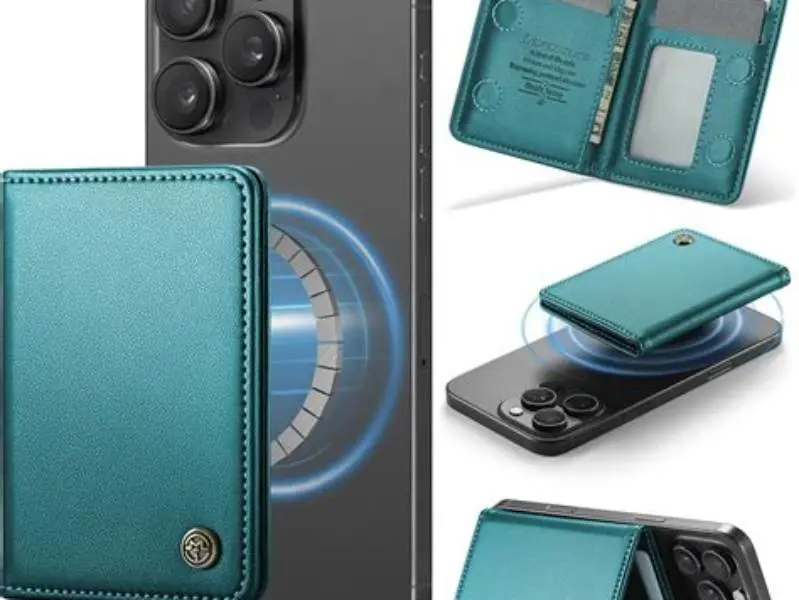
A MagSafe wallet uses a ring of magnets around its perimeter that measures 600-800 gauss at the surface, depending on the brand. Apple's own wallet sits at the lower end, around 600-650 gauss. Third-party wallets often push 750-800 gauss to grip harder. That's strong enough to hold the wallet firmly against a bare phone back, even with three cards inside and the phone hanging upside down.
The magnetic field drops fast with distance. At 2mm away (roughly the thickness of a slim leather case) the field strength falls to 350-450 gauss. At 5mm, which covers thicker leather cases with a card slot, you're down to 200-300 gauss. The falloff follows an inverse square relationship, so small increases in distance make big differences.
For comparison, a fridge magnet measures 50-100 gauss at the surface. A typical magnetic phone mount for a car outputs 400-600 gauss. MagSafe charging pucks run 500-700 gauss in the ring. The wallet magnets are stronger because they need to hold weight, but they're not unusually powerful in the world of consumer magnetics.
You can measure this yourself with a handheld gauss meter if you want certainty. Place the probe flat against the MagSafe wallet surface, note the reading, then slide your leather case between the meter and the wallet. The drop will match the figures above within 10-15 percent, depending on leather density and stitching. Most people don't need to measure: it's enough to know the wallet magnet sits on the opposite side of the phone from your case's card slot. If that sounds like your situation, read up on 2.5mm carbon-fiber case magnet test next.

AEGTEST 8103 Gauss Meter
Measures magnetic field strength up to 2500 mT with ±5% precision, suitable for checking magnet strength in MagSafe wallets.
What magnetic force actually damages card strips
Magnetic stripe cards store data by magnetizing tiny iron particles embedded in the strip. To erase or scramble that data, you need a magnetic field strong enough to flip those particles out of alignment. Lab tests put the damage threshold at 1000 gauss sustained exposure for most bank cards. Hotel keycards and older transit cards can fail at 800 gauss because they use thinner coatings with smaller particles.
The word sustained matters. A brief pass through a strong field won't do much. The card needs to sit in the field for several seconds to minutes while the magnet pulls the particles out of their encoded orientation. That's why swiping a card past a fridge magnet doesn't kill it, but storing the card against a magnet for days will.
Modern credit and debit cards have some defense built in. The magnetic layer sits about 0.3mm below the card surface, protected by a plastic overlay. That distance alone drops the effective field strength by 20-30 percent. Cards also use coercivity ratings: a measure of how much magnetic force it takes to flip the particles. Most bank cards sit at 2750 oersteds, which translates to needing a sustained field above 1000 gauss before damage starts. The other half of this decision is magnetic case with credit slot that doesn't block qi charging.
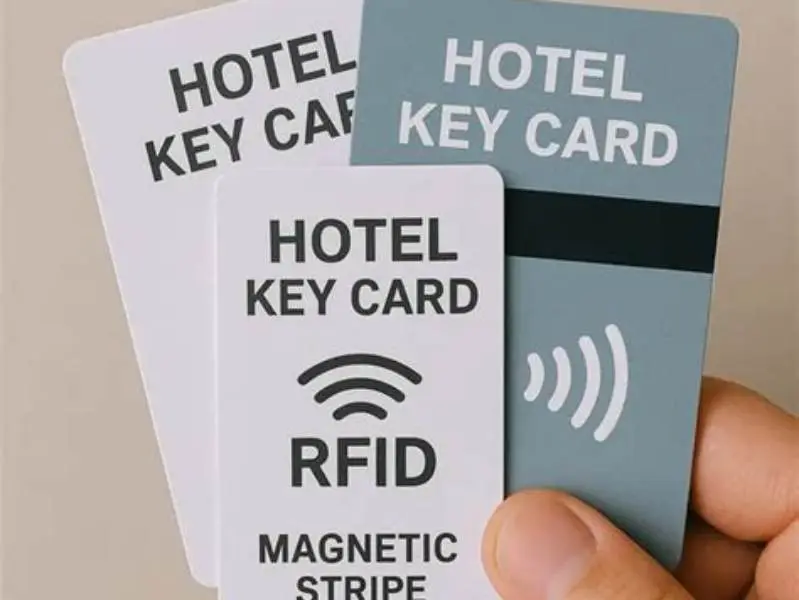
Hotel keycards are the weak link. They're often encoded at lower coercivity (around 300-600 oersteds) to work with cheap, worn-out readers. They'll demagnetize from sitting in a wallet next to another card with a magnetic strip, from heat in a back pocket, or from repeated flexing. Blaming the MagSafe wallet for a dead hotel key ignores that those cards fail constantly regardless of magnets.
| Card type | Coercivity (oersteds) | Damage threshold (gauss) | Typical failure cause |
|---|---|---|---|
| Credit/debit card | 2750 | 1000+ | Physical wear on strip |
| Hotel keycard | 300-600 | 800+ | Heat, friction, other cards |
| Transit card (old magnetic) | 600-900 | 900+ | Repeated swiping |
| Gift card | 2750 | 1000+ | Scratches, bending |
Effect of leather case thickness on magnet strength at card position
Leather cases for iPhones run 2-5mm thick at the back panel, excluding card-slot linings. Slim folio cases without slots sit at 2-3mm. A wallet case with one slot adds 1-2mm for the pocket and lining, so total thickness reaches 4-5mm.
Cases sold as premium can reach 6mm at stressed points like the spine. The back panel where the MagSafe ring attaches almost always stays under 5mm. If the back panel were thicker, the case would not sit flat and the MagSafe connection would fail. We cover iphone 15 mini magsafe charging in its own article.
Every additional millimeter of leather reduces the field strength by about 60-80 gauss at the far side of the case. A 3mm case lowers a 700-gauss wallet to roughly 460-520 gauss at the inside surface. A 5mm case drops it to about 280-340 gauss.
Leather type shifts the numbers slightly. Veg-tanned full-grain leather blocks a bit more than corrected-grain or bonded leather. Denser fibers yield a larger gauss drop for the same thickness.
Cards placed inside a back-slot sit behind the phone body, not directly behind the wallet magnet. Add the phone’s glass, chassis, and internals. That stack adds roughly 7-8mm. The total gap between the magnet and a card's magnetic strip is about 10-13mm.
At 10-13mm distance the field reaching the card falls to about 50-120 gauss. Those levels match common background magnetic exposure. They do not approach the coercivity thresholds that erase standard magnetic stripes.
- Slim leather case,
2-3mm: field strength at inside surface 400-500 gauss - Standard wallet case,
4-5mm: field strength at inside surface 280-340 gauss - Thick folio case,
6mm+: field strength at inside surface 200-260 gauss - Through case plus phone body to card slot: 50-120 gauss, no risk
The MagSafe ring magnets are strong enough to hold your wallet but too far from your case's card slots to reach the demagnetization threshold.
Will a MagSafe wallet in my leather case demagnetize cards inside
No. Cards inside a leather case sit about 10-13mm away from the MagSafe wallet ring. Leather, the phone body, and a small air gap separate the magnet from the card strip.
At 10-13mm the field measures around 50-120 gauss. That is roughly one-tenth the field needed to damage typical magnetic strips. Damage requires much stronger fields or sustained close contact.
Early user reports of dead keycards looked alarming. Follow-up details changed the picture. Those keycards had been stored inside wallets or placed directly against the magnet. A keycard inside the wallet can sit at 1-2mm distance where the field can reach 500-600 gauss.
Even at 500-600 gauss, most credit and transit cards hold up. Cheap low-coercivity hotel keycards can fail after short exposure if pressed directly against the magnet. Credit cards use higher coercivity and resist far better.
Geometry reduces risk. The MagSafe ring is about 55mm across and centered on the phone back. Card slots sit offset. The magnetic strip on a card usually ends up 60-80mm from the nearest magnet edge along a diagonal.
That diagonal distance cuts the field further into about 30-70 gauss. At those levels interference is indistinguishable from normal background noise.
If you want certainty, run a simple test. Use an expired gift card or old transit card. Place it in your case slot with the MagSafe wallet attached for seven days. Swipe it afterward. Real-world checks beat theoretical worry.
Common user experiences and real-world tests
Apple's guidance says MagSafe accessories do not damage credit cards or transit cards when used as designed. Apple tested typical distances and field strengths after the iPhone 12 launch and found no demagnetization.
Apple warns against placing cards between the phone and a MagSafe battery pack. Those packs sit closer and can produce stronger local fields. Even there the company describes the risk as low.
Independent testers reproduced the same outcome. One tester left a credit card pressed directly against an Apple MagSafe wallet for 72 hours. The card still worked. Another measured the field around a MagSafe wallet on an iPhone 13 Pro in a leather case, then monitored cards in the slot for two weeks. No failures happened.
Consumer complaints follow a repeatable pattern. People report a dead card and name the MagSafe wallet. Deeper questions reveal the card was an old transit card, a short-lived hotel keycard, or a card kept with keys and coins. Mechanical wear and stray magnets often explain the failure.
If magnets caused widespread failures, NFC payments would show issues. Apple Wallet and Google Pay show no spike in contactless failures for phones with MagSafe. That indicates the field remains localized to the ring and does not disrupt nearby electronics or payment chips.
Passport RFID chips are also safe. Those chips use radio-frequency read-only tags, not magnetic encoding. A static magnet at MagSafe strengths cannot erase or reprogram an RFID chip.
Where to keep cards if you're still concerned
If the explanations above don't settle your nerves, rearrange where you keep high-value cards. Put your main credit or debit card in the MagSafe wallet itself, not the leather case. That sounds backward, but the wallet's card slots face outward, away from the magnet ring. A card stored there sits 8-10mm from the magnets with the wallet's leather or fabric between them, and the magnetic strip points away from the field. Field strength at the card strip drops to 40-80 gauss, lower than keeping the card in the case.
Hotel keycards and single-use transit cards go in a different pocket entirely: your back pocket, a jacket, or a separate cardholder. Those cards aren't worth protecting with elaborate storage. They'll fail from heat, friction, or expiration long before magnets become the culprit. Save the MagSafe wallet and case slots for cards you use daily and can replace easily if something goes wrong.
Another option: rotate to a non-leather case without a card slot and carry a separate cardholder. MagSafe wallets attach just as well to silicone, plastic, and clear cases, and those materials don't trap heat the way leather does. Heat is a bigger enemy of magnetic strips than weak magnetic fields. A leather case in a hot car or a back pocket during summer can push internal temps to 50-60°C, which softens the binder holding the iron particles in the strip and makes them easier to demagnetize or smear.
Switch to contactless payment as your primary method and treat the magnetic strip as a backup. Most bank cards issued in the last three years prioritize NFC over swiping. The magnetic strip is still there for compatibility with old terminals, but it's not the card's main function anymore. If it fails, you can still tap to pay while you wait for a replacement. That mindset shift makes the entire question less urgent.
FAQ
Can a MagSafe wallet demagnetize my phone itself?
No. Phones don't store data on magnetic media anymore: they use flash memory and solid-state storage, neither of which responds to magnetic fields. The compass sensor might show a temporary offset near a strong magnet, but it recalibrates automatically when you move the magnet away.
Is there a difference between Apple's MagSafe wallet and third-party ones in terms of magnet strength?
Third-party wallets often use slightly stronger magnets (750-800 gauss instead of Apple's 600-650 gauss) to create a firmer grip. That extra 100-150 gauss doesn't change the safety margin. Even at 800 gauss on the surface, the field drops to 200-400 gauss through a leather case, still well under the demagnetization threshold.
Will leaving my MagSafe wallet attached overnight damage cards over time?
No. Demagnetization requires sustained exposure above 1000 gauss. A MagSafe wallet produces 200-400 gauss through a case, and that field strength doesn't accumulate over time. A month of exposure at 300 gauss does the same nothing as an hour at 300 gauss.
Can I use a MagSafe wallet with a thick leather case, or does the case block the magnetic grip?
MagSafe wallets work through cases up to 5-6mm thick, though the grip gets noticeably weaker above 4mm. If your case is thicker than that, the wallet may slide or fall off with normal handling. You'll know within the first day whether the hold is strong enough for your use.
Do older magnetic stripe cards demagnetize more easily than new ones?
Yes. Cards lose coercivity as the magnetic particles age and the binder degrades. A card that's three or four years old and has been swiped hundreds of times is more vulnerable to demagnetization than a fresh card, but even a worn card needs exposure above 800-900 gauss to fail. Normal MagSafe use won't reach that.