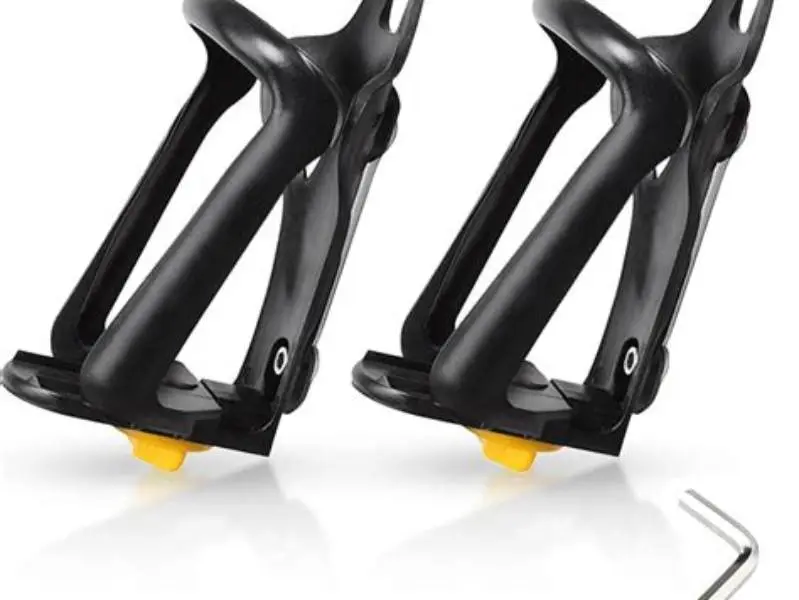
How much magnet a full 1 litre steel bottle actually needs

A full 1 litre steel bottle usually weighs about 1.3 to 1.6 kg. A short contact patch can multiply the load at the magnet. Treat any pull rating as a best-case figure, then test the exact holder on your rack and bottle. If the bottle fails the magnet test, use a cradle, strap, or clamp.
On this page (13 sections)
- Fit check
- Remember this
- Choosing a magnetic bottle holder: start with your setup
- Bottle weight and lever geometry: measure both
- Holder size: contact patch matters
- Rack surfaces: thick steel is not thin sheet metal
- Quoted pull: what the number leaves out
- Shear and peel: the usual failure
- Bottle alloy test: don't assume stainless means magnetic
- Magnetic holder types: compare the real options
- Bench test: find where your assembly creeps
- When a strap, cradle, or clamp makes more sense
- FAQ

ROCKBROS Magnetic Strap Water Bottle Holder with Quick-Release
If your rack's paint kills magnet pull entirely, the silicone strap wraps around the upright and a buckle
Check it on Amazon
SMRCAD 4 Pack Iron Magnetic Water Bottle Holder for Tumbler
A four-pack of iron magnetic cages rated 9 lbs (about 4.1 kg) each fits 20–40 oz tumblers, and the included
See the budget option
Magnetic Gym Bag & Water Bottle Holder for Squat Rack
Your full 1 L steel bottle weighs about 1 kg, but on a painted upright the magnet works in shear, so you want
Check the specs on Amazon| Product | rated pull force under stated test conditions | Verdict | |
|---|---|---|---|
| ROCKBROS Magnetic Strap Water Bottle Holder with Quick-Release Button ROCKBROS | no rated pull force published; strap fits 30–60 mm diameter uprights | No force published | View on Amazon |
| SMRCAD 4 Pack Iron Magnetic Water Bottle Holder for Tumbler 20/30/40 SMRCAD | 9 lbs (~4.1 kg) per shelf vs ~4 kg needed; screw mount as backup | Meets it | View on Amazon |
| Magnetic Gym Bag & Water Bottle Holder for Squat Rack Generic | 5 kg rated hold vs ~4 kg needed for a full 1 L bottle in shear | Not published | View on Amazon |
| sportsnew Magnetic Water Bottle Holder for 40oz Tumbler Gym Hiking sportsnew | 2.5 kg rated vs ~4 kg wanted in shear on painted steel | Short by 37% | View on Amazon |
Fast facts
- Full bottle weight
- often about 1.3 to 1.6 kg
- Worked lever model
- 15 cm bottle drop and 4 cm contact height
- Real-world pull
- often well under half the listing rating
- Best first test
- small fridge magnet on bottle and rack
- Magnetic mounting
- best on thick, flat, bare steel
- Bench test target
- above the load where creeping starts
Remember this
- Weigh your full bottle before choosing a holder
- Measure the bottle drop and holder contact height
- Pull ratings apply to flat bare steel unless stated otherwise
- Paint, curvature, and thin walls can cut real holding force sharply
- Test the bottle and rack with a small fridge magnet
- A strap, cradle, or clamp avoids many alloy and surface problems
Choosing a magnetic bottle holder: start with your setup
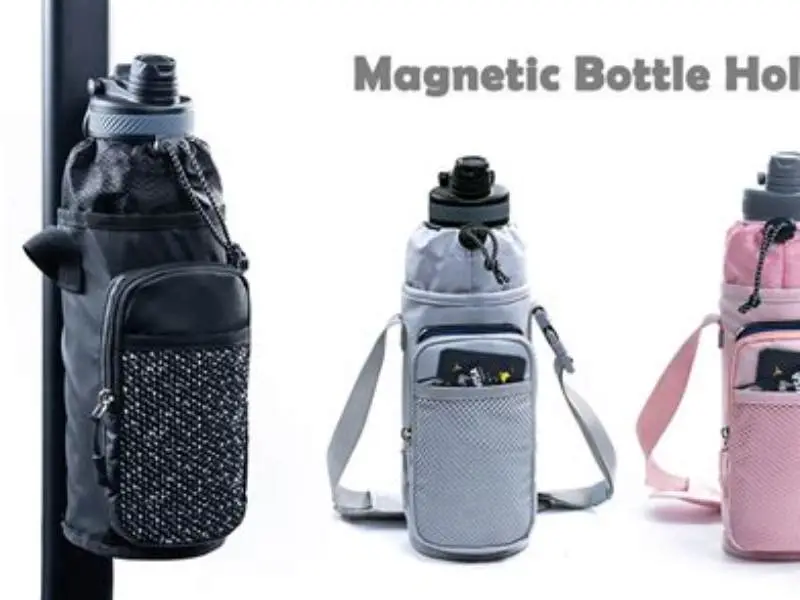
A magnetic bottle holder can keep your bottle off the gym floor. It can also drop the bottle or slide down the rack. The difference comes from the bottle alloy, holder geometry, and mounting surface.
Listings usually quote a pull figure from a clean test on thick, flat steel. Your rack may be painted or curved. Your bottle may be thin stainless steel. Measure those parts before trusting the number.
Bottle weight and lever geometry: measure both
One litre of water weighs 1 kg. A steel bottle, lid, and gasket add weight. Many full bottles land around 1.3 to 1.6 kg, but your scale gives the useful number.
Measure from the top edge of the holder's contact patch to the bottle's centre of mass. Measure the vertical height of the contact patch. These distances control the rough lever model. There is more on how to measure your frame rail in a separate guide.
Suppose the bottle centre sits about 15 cm below a 4 cm contact patch. The simple ratio is 15 divided by 4, or about 3.75. A 1.4 kg bottle then creates roughly 5.3 kg-centimetres of turning load, expressed as about 5.3 kg at a 4 cm contact height. This is an illustrative model, not a measured magnet demand.
The model ignores friction, peel angle, padding, and movement. Measure your own holder instead. A taller contact patch can reduce the ratio. A holder that sits farther from the rack can increase it.
| Quantity | Illustrative value | How to replace it |
|---|---|---|
| Water mass | 1.0 kg | One litre by definition |
| Bottle, lid, and gasket | 0.3 to 0.6 kg | Weigh the empty bottle |
| Full bottle mass | 1.3 to 1.6 kg | Weigh yours full |
| Bottle centre below contact | 15 cm | Measure your holder |
| Contact patch height | 4 cm | Measure the actual patch |
| Lever ratio | 15 divided by 4 | Use your two measurements |
| Effective turning load | Illustrative only | Calculate from your measurements |
| Required rating | No universal figure | Confirm with a bench test |
Holder size: contact patch matters
Typical magnetic bottle holders use a disc base, a flat plate, or a rubber-coated magnetic block. The magnetic base may measure roughly 40 to 80 mm across. Complete holders often weigh about 200 to 600 g, depending on the cage and magnet. It helps to understand magnetic charging cable for phone with worn charging port before going further.
Check the contact patch, not just the magnet diameter. A patch around 40 mm high matches the example above. A wider patch can resist peel better, but area doesn't translate directly into pull.
Measure the holder before buying. A large cage with a small magnet still has a small magnetic connection.
Rack surfaces: thick steel is not thin sheet metal
A squat rack with a thick steel upright gives a magnet more material to work against. Bare machined steel is the easiest case. Painted rack tubing adds an air gap, and rubberised coatings add more. We go through what is a qi enabled phone step by step elsewhere on the site.
Thin sheet-metal squat stands can be a poor match. The sheet may flex, offer less steel behind the magnet, or lack enough flat area. A magnet can hold well on a thick upright and poorly on a thin stand.
Test the exact mounting spot. A barbell plate, steel door, or other nearby surface does not prove your rack will work.
ROCKBROS Magnetic Strap Water Bottle Holder with Quick-Release Button
If your rack's paint kills magnet pull entirely, the silicone strap wraps around the upright and a buckle carries the bottle mechanically, fitting 30–60 mm tubing, so the magnet only has to stop rotation, not hold 1 kg.
- Length 6.3 inches
- Height 1.69 inches
- Width 5.51 inches
Quoted pull: what the number leaves out
A listing's pull figure normally assumes a flush magnet on thick, flat, bare mild steel. It often measures a straight pull away from that surface. A bottle holder creates shear and peel instead.
Powder coat and rubberised coatings create an air gap that sharply reduces pull. Thicker coatings are worse. Curved surfaces reduce contact, while a thin bottle wall cannot behave like a thick steel plate.
Pull force drops steeply and nonlinearly with any air gap. Don't convert a listing number with a fixed percentage. Test the real assembly instead.
Real-world holding force can be a small fraction of the rating, often well under half. Use the bench test below as your anchor. Treat published ratings as comparisons between products, not as working force.
| Condition | Effect | Your check |
|---|---|---|
| Thick bare flat steel | Closest to the listing test | Compare the stated test surface |
| Paint or rubber coating | Creates an air gap | Test on the coated rack |
| Curved upright | Reduces the contact area | Check where the magnet actually touches |
| Thin bottle wall | May offer weak magnetic coupling | Test the bottle side |
| Shear or peel | Loads the holder differently | Pull the complete holder downward |
Shear and peel: the usual failure
A hanging bottle rarely pulls straight away. It slides down the rack or peels from one edge. Friction, contact area, and holder shape then matter as much as magnet strength.
Rubber or silicone on the magnet face can improve friction. It may reduce direct pull, but it can stop sliding. A wider plate can resist peel better than a small disc.
SMRCAD 4 Pack Iron Magnetic Water Bottle Holder for Tumbler 20/30/40 oz
A four-pack of iron magnetic cages rated 9 lbs (about 4.1 kg) each fits 20–40 oz tumblers, and the included screws let you bolt one to the upright so paint thickness stops mattering.
- Height 3.0 inches
- Length 3.8 inches
- Width 11.5 inches
The number on the box comes from a clean steel test. Your rack and bottle need their own test.
Bottle alloy test: don't assume stainless means magnetic
Stainless steel comes in several grades. Some bottle grades barely attract a small magnet. Some bottles end up slightly magnetic depending on the grade and how they were formed. Test rather than assume.
Use a flat fridge magnet on the bottle wall where the holder will sit. A firm grab is promising. A weak slide or no attraction points toward a cradle or strap.
Test the rack at the same time. Both surfaces must suit the holder.
- Fill the bottle and weigh it
- Press a small fridge magnet to the bottle wall
- Score the grip as firm, weak, or absent
- Test the rack at the planned mounting spot
- Choose a magnetic holder only if both tests pass
Magnetic holder types: compare the real options
Disc-base cages use one or more round cup magnets under a bottle cage. They are compact and often cost about $20 to $45. Check the stated pull test, disc diameter, contact height, and whether the face is coated.
Rubber-coated magnetic mounts use a flat plate or block. They often cost about $25 to $60. The coating can help with sliding, but it also creates an air gap. Product names vary, so search for a bottle cage with a rubber-coated magnetic base.
Strap-wrap mounts carry the bottle in fabric or webbing. A large flat magnet attaches the wrap to the rack. These often cost about $30 to $70. The strap carries the bottle load, so the bottle alloy matters less.
Brands such as Magswitch and K&J Magnetics sell magnetic bases and cup magnets rather than complete gym bottle holders. Their published figures can help compare magnet hardware, but don't treat a component rating as a finished-holder rating. Check the exact test surface and load direction.
A clamp-on cage usually costs about $20 to $50. It holds any bottle mechanically and suits a permanent squat rack. A simple cradle can cost about $15 to $40. Prices vary by material and mounting hardware.
Bench test: find where your assembly creeps
Use the exact holder, bottle, rack coating, and orientation. Add a luggage scale or known weights. The test measures your setup better than a catalogue figure.
Fit the holder to the rack. Put the full bottle in place. Pull downward slowly from the bottle or its strap. Watch for the bottle sliding, the holder sliding, or one edge peeling.
Record the load where movement starts. Stop before the holder drops. Repeat after repositioning it. A safe working margin depends on your training space, impacts, and how often the rack moves.
| What moved | Meaning | Practical fix |
|---|---|---|
| Bottle slid out | Bottle-side grip or cage shape is weak | Use a strap, cradle, or better cage |
| Holder slid down | Rack-side friction failed | Use a rubber face or clamp |
| Holder peeled | Contact patch or geometry is poor | Use a wider plate or strap mount |
| Nothing moved | This setup passed the test | Keep checking after use |
When a strap, cradle, or clamp makes more sense
A cradle holds the bottle mechanically. It works with magnetic and non-magnetic bottles. A strap-wrap mount adds portability while keeping the bottle supported.
A clamp-on cage suits a fixed squat rack. It avoids the rack-side friction problem and does not depend on magnetic flux through paint. The tradeoff is slower repositioning.
Strong magnets can temporarily affect compass readings and some sensors. Keep cards with magnetic stripes well away.
A magnetic holder can work when the bottle wall and rack both pass the magnet test. Measure the holder, bench-test it full, and use a strap, cradle, or clamp when the setup fails.
FAQ
Will a magnetic holder work on an insulated bottle?
Only if the bottle wall attracts the test magnet. Check the exact wall area used by the holder. A weak response calls for a cradle or strap.
Is a stronger magnet dangerous near my phone or cards?
Keep magnetic-stripe cards away from strong magnets. Phones can show temporary compass or sensor errors nearby. Keep the holder away from cards and sensitive sensors.
Why does my holder hold the bottle but slide down the rack?
The rack-side connection is failing in shear. Try a rubber-faced mount or a clamp. A higher pull rating may not solve a friction problem.
What pull rating should I look for?
Use the rating to compare similar products, then bench-test the exact assembly. There is no honest universal rating without your bottle mass, lever distances, contact patch, coating, and test surface.
Does bottle orientation matter during the magnet test?
Yes. Test the wall where the holder will grip. A magnetic base does not prove the sidewall will hold.